
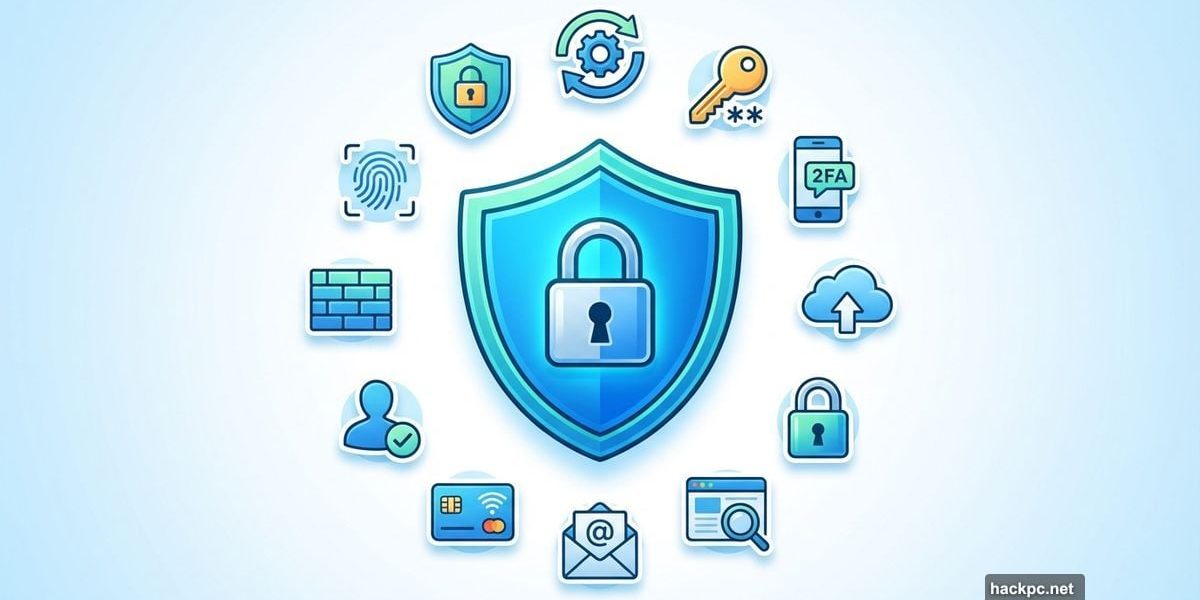
Online security sounds complicated. Firewalls, encryption, zero-day exploits—it’s enough to make anyone want to throw their laptop in a lake.
But here’s the thing: You don’t need a computer science degree to protect yourself online. Most cybersecurity threats rely on simple tricks, not technical wizardry. So the solutions can be simple too.
These 12 steps won’t take hours or cost a fortune. In fact, many are completely free. Plus, even if you only tackle one or two, you’ll be dramatically safer than you were yesterday.
Install Every Security Update Immediately
This one’s boring but critical. When your phone or laptop nags you about updates, don’t hit “remind me later.” Download them right away.
Security updates patch vulnerabilities that hackers can exploit. Once developers discover a flaw, they rush out a fix. But by that time, cybercriminals usually know about the problem too.
Every day you delay is another day you’re vulnerable. So make it a habit: See the notification, tap install, move on with your life.
Not every update is about security. Some just add features or fix bugs. However, the ones that matter most are protecting you from real, active threats.
Create Passwords That Actually Work
Weak passwords cause more breaches than almost anything else. If your password is “password123” or your birthday, hackers can guess it in seconds.
Even random passwords fail if they’re too short. Attackers use programs that try every possible combination until something works. The longer your password, the harder this becomes—exponentially so.
That means you need long, random passwords for every account. Sounds impossible to remember, right? That’s where password managers come in.
A password manager generates strong passwords, stores them securely, and fills them in automatically. You only need to remember one master password that unlocks everything else.
Popular options include 1Password, Bitwarden, and Dashlane. Most work across all your devices and sync instantly.
Add Two-Factor Authentication Everywhere
Strong passwords help, but they’re not foolproof. Data breaches can expose even the best passwords through no fault of your own.
Two-factor authentication (2FA) adds a second layer of protection. Even if someone steals your password, they can’t get in without the second factor—usually a code sent to your phone or generated by an app.
Plus, many services now support passkeys. These use encryption to verify your identity without requiring you to type anything. They’re faster and more secure than traditional 2FA.

Set up 2FA on every account that supports it. Start with email, banking, and social media. Then work your way down to everything else.
Back Up Everything, Everywhere
Ransomware attacks are growing fast. Hackers encrypt your files and demand payment to unlock them. Or they threaten to delete everything unless you pay up.
The easiest way to beat ransomware? Have backups ready. If your files get locked, restore them from backup and move on.
Security experts recommend the 3-2-1 rule: Three copies of your data, on two different types of storage, with one stored offsite.
For example, keep one backup on an external hard drive at home. Store another in the cloud. Keep a third on a different device.
Automatic backup services like Backblaze or Carbonite handle this for you. Set them up once and they’ll save your data at regular intervals without you having to think about it.
Recognize Social Engineering Tactics
Despite all the technical talk, most scams rely on old-fashioned manipulation. Hackers pose as authority figures, create fake emergencies, and use fear to bypass your common sense.
Phishing emails are the classic example. A message claims to be from your bank, credit bureau, or subscription service. It warns about urgent problems with your account. Then it demands your password or Social Security number to fix it.
Other common tricks include fake speeding tickets, bogus purchase receipts, and warnings about tax problems. The goal is always the same: panic you into giving up information.
Take a breath whenever you get a scary message. Then investigate before you do anything. Check the sender’s email address carefully. Look at the visual design—does it actually match the company it claims to be from?
Moreover, ask yourself if the message even makes sense. Your bank won’t ask for your password via email. The IRS doesn’t collect unpaid taxes through iTunes gift cards.
Always Verify Links Before Clicking
Social engineering doesn’t stop at tricking you into handing over information. Hackers also use malicious links to install malware on your device.
These programs can record everything you type (including passwords), corrupt your files, or give attackers remote access to your system.
Before clicking any link in an email or text message, copy it and paste it into a URL checker. Services like NordVPN‘s link checker can tell you if a URL is associated with known malware.
You can also hover your mouse over any link to see where it actually goes. Check the bottom-left corner of your browser—the real destination appears there.
If an email claims to be from your bank, every link should go to your bank’s official website. If it points anywhere else, especially a random string of characters, don’t click it.

One more thing: Never copy-paste commands into your computer’s terminal or command prompt unless you’re absolutely certain what they do. This goes double for commands suggested by AI chatbots, which can be tricked into recommending malicious code.
Stop Broadcasting Your Life Details
Social media trained us to share everything. Vacation photos, kids’ names, birthdays, pet names—it all seems harmless until you realize how much ammunition you’re giving to scammers.
Grandparent scams are surging right now. Grifters call seniors pretending to be their grandchildren in crisis. The more personal information they have, the more convincing their story becomes.
Plus, oversharing compounds other security problems. If you use weak passwords, public information can help hackers guess them. Security questions like “What’s your mother’s maiden name?” become useless if the answer is on Facebook.
Think twice before engaging with those “fun quizzes” that ask about your first pet or childhood street. Those answers are often used as security questions.
Share less online. Your real friends already know what matters. Everyone else doesn’t need to.
Use a VPN for Privacy and Protection
Virtual private networks (VPNs) get hyped as total security solutions. They’re not. However, they do protect you in specific, important ways.
A VPN replaces your IP address with the address of a VPN server. That server does business with websites on your behalf while encrypting the connection between your device and itself.
This means nobody can connect your online activity to your real identity. Data brokers can’t build profiles on you. Governments can’t track your browsing. Hackers setting up fake Wi-Fi networks can’t intercept your traffic.
Many top VPNs include ad blockers that stop cookies and tracking pixels from latching onto you. Proton VPN is my top pick for balancing privacy, speed, and features.
But remember: A VPN can’t save you from weak passwords or phishing links. It’s one layer of protection, not a magic shield.
Run Antivirus Scans Regularly
Catching malware as it arrives is crucial. A good antivirus program scans files as you download them, quarantining anything suspicious until it knows whether it’s safe.
Modern antivirus software uses machine learning to spot new threats. It learns the patterns that malware follows, catching even brand-new viruses that haven’t been documented yet.
However, some malware slips through. That’s why you need regular scans of your entire system. Schedule your antivirus to check everything weekly.
Windows comes with Windows Defender built in. It’s decent for basic protection. But I recommend adding at least one dedicated anti-malware program for extra coverage.

Malwarebytes offers a solid free version. Bitdefender and Norton are popular paid options with more features.
Hide Your Real Email and Search History
The less personal information you put online, the safer you are. Email maskers and private search engines help you stay anonymous without giving up convenience.
Email maskers give you temporary addresses for signing up for accounts. Messages sent to the fake address forward to your real inbox automatically. If the service gets breached or sells your data, your actual email stays safe.
Services like SimpleLogin and DuckDuckGo’s Email Protection offer this for free.
Search engines, especially Google, track every term you search to build advertising profiles. Switch to DuckDuckGo for searching instead. It doesn’t track anything you do and funds itself through non-targeted ads.
These tools won’t protect you from everything. But they dramatically reduce how much of your data floats around for sale or theft.
Remove Your Data From Broker Databases
Data brokers are businesses that collect and sell personal information. If you’ve been online for the last decade without intense precautions, dozens of these companies probably have files on you.
They’re poorly regulated and terrible at security. The longer they keep your data, the more likely it leaks in a breach.
The good news? Most brokers legally have to delete your information if you request it. The bad news? There are hundreds of brokers, and each makes opting out deliberately difficult.
Data removal services like DeleteMe and Incogni handle this for you. They contact brokers on your behalf and monitor for your data reappearing.
It’s not a perfect solution. But it’s far easier than spending hundreds of hours submitting deletion requests yourself.
Don’t Forget Physical Security
Digital security matters, but physical access to your devices is still a threat. Someone could install malware via USB drive if you leave your laptop unattended. Or steal your unlocked phone after watching you type the passcode.
One documented case involved a thief loitering in bars, watching people unlock their phones, then stealing those phones and accessing everything.
Lock your devices with biometric authentication—fingerprint or face recognition. Don’t leave phones or laptops lying around in public spaces. And at work, don’t let anyone into secure areas without proper credentials.
Physical security isn’t paranoia. It’s the same common sense you use to protect your car or house.
These steps won’t make you invincible. Nothing will. But each one dramatically reduces your risk and makes you a harder target. Hackers usually go after easy victims. Don’t be one of them.



Comments (0)