
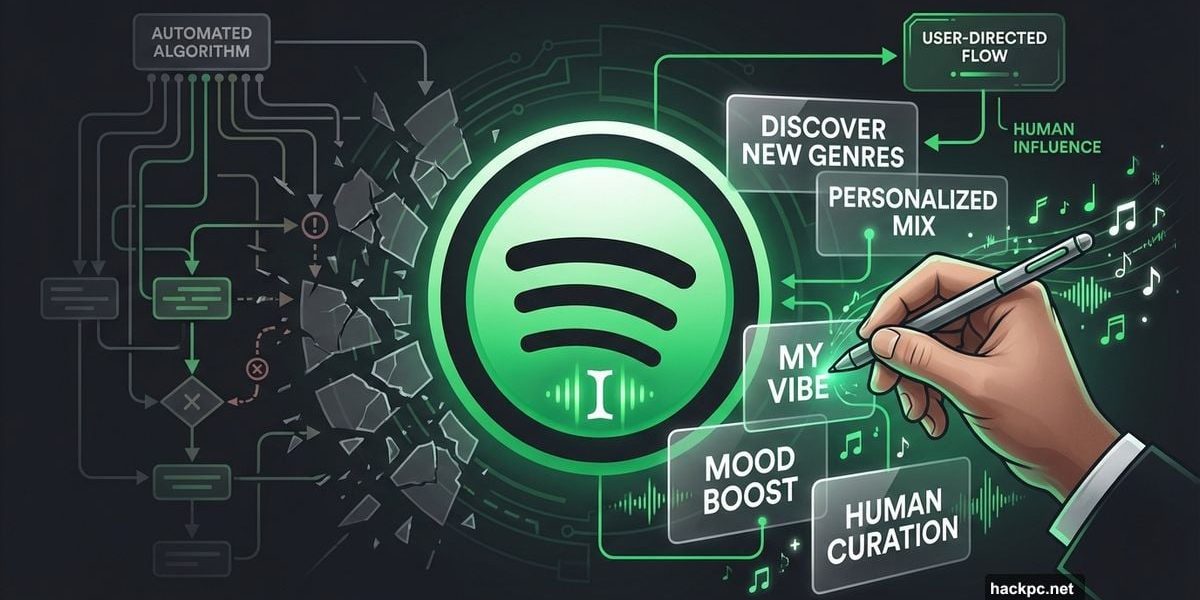
Spotify‘s recommendation engine just got personal. The streaming giant rolled out “Prompted Playlist” in beta, letting users tell the algorithm exactly what they want to hear.
Sounds liberating, right? But there’s something odd happening here. Companies spent years promising their algorithms would magically know what we want. Now they’re admitting we need to tell them instead.
Let’s dig into what Spotify actually built and why it matters.
You Write the Prompt, Spotify Builds the Mix
Prompted Playlist works like ChatGPT for music. Users type what they want to hear, and Spotify generates a custom playlist based on that request plus their entire listening history.
The feature launched December 11 in New Zealand as a beta test. Only English prompts work for now, but Spotify says more languages are coming.
Here’s what makes it different from past attempts. First, it taps your complete Spotify history from day one. Previous AI features only looked at recent listening patterns. Second, you get granular control over prompts instead of picking from preset options.

Plus, Spotify explains why it chose each song. That feedback loop helps users refine future prompts and understand the algorithm’s logic. Most streaming services keep that reasoning hidden.
Prompts Can Get Specific or Stay Broad
Spotify says users can be as detailed or vague as they want. Need background music for coding? Type that. Want songs that sound like early Radiohead but aren’t actually Radiohead? Ask for it.
The setup screen includes an “Ideas” tab for inspiration if you’re stuck. And playlists can auto-update on a schedule, pulling in new releases that match your original prompt.
That auto-update feature matters more than it seems. Traditional playlists go stale fast. But a prompt-based playlist that refreshes weekly stays relevant without manual curation.
Moreover, users can tweak prompts after seeing results. Don’t like the vibe? Adjust your instructions and regenerate. It’s iterative rather than one-and-done.
Everyone’s Suddenly Offering Algorithm Control

Spotify isn’t alone in this shift. Meta recently added algorithm-tuning tools to Threads and Instagram. TikTok lets users completely reset their For You page.
Why the sudden change? User complaints about recommendation bubbles reached critical mass. People felt trapped by algorithms that assumed too much or got stuck in loops.
So platforms are responding with control features. But here’s the irony: These same companies spent billions developing algorithms that supposedly didn’t need user input. The promise was always “We’ll figure out what you like automatically.”
Now they’re admitting that automation has limits. Users often know better than the algorithm what they want in the moment.
The Real Question: Is This Progress or Admission of Failure?
Prompted Playlist sounds innovative. But it’s also Spotify acknowledging their recommendation engine can’t read minds.
Think about it. If Spotify’s algorithm truly understood your taste, you wouldn’t need to prompt it. The AI would just know when you want workout music versus chill background tracks versus new discovery mode.
Instead, Spotify is asking users to do the work. You describe what you want. The algorithm executes. That’s not AI doing the heavy lifting—that’s AI as a better search tool.

And honestly? That might be the smarter approach. Algorithms guess. Users know. Combining both gives better results than either alone.
What This Means for Streaming’s Future
Other platforms will copy this. Apple Music, YouTube Music, Amazon Music—they’ll all roll out prompt-based playlists within months.
The streaming wars just shifted from “best catalog” to “best control.” Users care less about having 100 million songs if they can’t find what they actually want to hear right now.
So expect more tools that let you guide algorithms rather than just trusting them. The pendulum swung too far toward full automation. Now it’s swinging back toward user input.
But there’s a risk. If prompting becomes mandatory for good recommendations, streaming services just added friction. The whole point was supposed to be effortless music discovery.
Spotify’s betting users want control more than they want convenience. Time will tell if that’s right. But for now, at least New Zealand subscribers can tell their algorithm exactly what to do instead of hoping it guesses correctly.



Comments (0)