
Privacy isn’t about secrecy. It’s about control.
I don’t break laws online. I’m not dodging government surveillance or hiding sketchy activity from my internet provider. Yet I run a VPN every single day. Why? Because my ISP watches everything I do online, logs it, and sells that data to advertisers.
That’s not paranoia. It’s in their privacy policy.
Your Internet Provider Knows Too Much
AT&T’s privacy policy reads like a surveillance manual. The company tracks my location data, websites visited, time spent on each site, IP addresses, search terms, videos watched, and even items I put in online shopping carts.
Then they share it. With AT&T affiliates. With advertisers. With “non-AT&T companies for advertising and marketing.” And when authorities request it, with law enforcement.
Spectrum does the same thing. So does Comcast. Most major ISPs operate this way. They harvest your browsing habits and package them for profit.
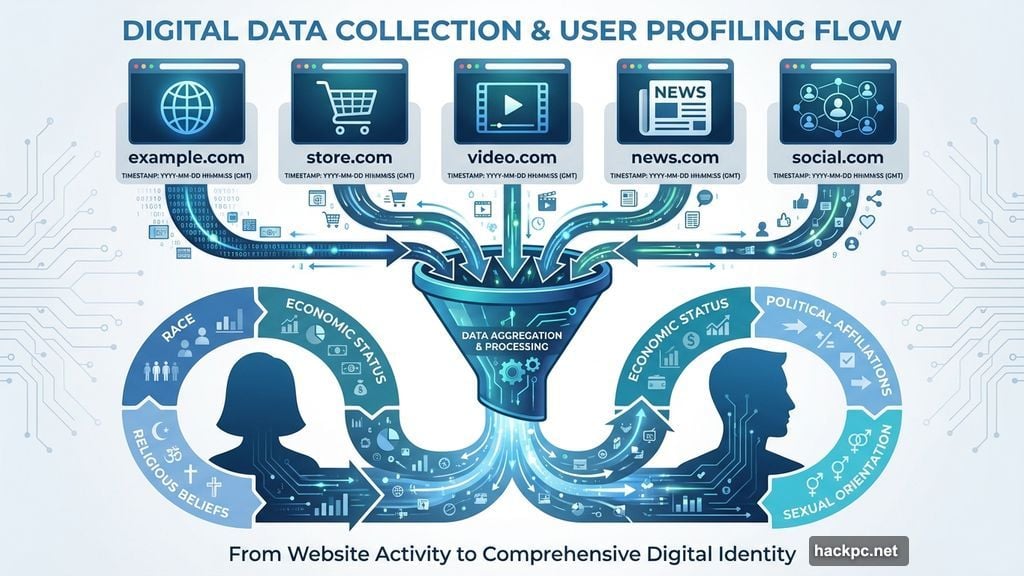
The Federal Trade Commission published a 74-page report in 2021 exposing how deep this goes. ISPs place users into segments revealing sensitive information like race, ethnicity, sexual orientation, economic status, political affiliations, and religious beliefs. All gleaned from monitoring what you do online.
Four years later, nothing’s changed. No comprehensive federal privacy law exists. State laws help, but they’re inconsistent and full of loopholes. ISPs still collect massive amounts of user data and share it freely.
What Your ISP Actually Sees
Most websites now use HTTPS encryption. So your ISP can’t see everything—just most things that matter.
They can’t see the specific pages you visit on encrypted sites. They won’t see your passwords, credit card numbers, or personal information entered into web forms. But they see plenty.
Your ISP logs the domain names of every website you visit. When you visit them. How often. How much data you transfer. Your IP address. Connection timestamps.
That’s enough to build a detailed profile. Even when data gets “aggregated” before sharing with advertisers, researchers repeatedly prove it can be re-identified and traced back to individuals.
Plus, depending on your location, ISPs can throttle your speeds based on what you’re doing. Streaming too much? Gaming heavily? They might deliberately slow you down to “balance network load.”
How a VPN Changes Everything
When I connect to my VPN, my ISP’s visibility drops dramatically.
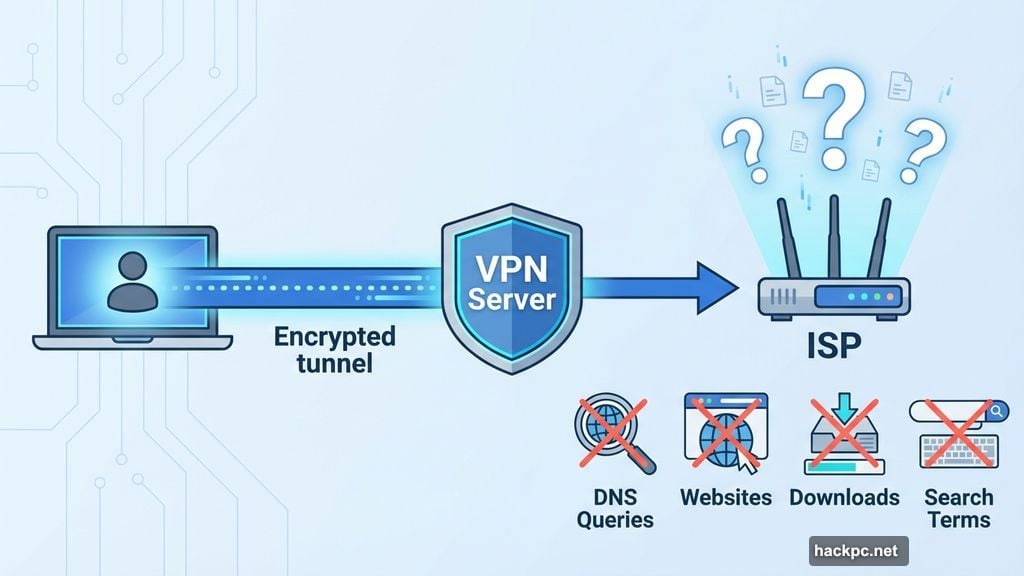
They see my IP address and my VPN server’s IP address. Connection timestamps. Data volume. The VPN protocol I’m using. That’s it.
They don’t see which websites I visit. Which apps I use. My DNS queries. Files I download or upload. Search terms. Nothing about how I spend time online.
This blocks my ISP from building a profile on me for ad targeting. More importantly, if they’re not collecting that data, cybercriminals can’t steal it during a breach. Data that doesn’t exist can’t be compromised.
However, VPNs aren’t magic cloaks of invisibility. Google and Meta still track you across their services when you’re logged in. A VPN hides your activity from network-level surveillance, not from the platforms themselves.
VPNs Solve Real Problems
Content throttling is rare in the US now. But in regions where ISPs slow specific types of traffic, a VPN helps. If they can’t see what you’re doing, they can’t throttle based on activity.
Internet censorship affects millions globally. School and work networks often block content or VPN use itself. Connecting to a server in an unrestricted country bypasses both problems.
Some VPNs offer obfuscated servers or protocols that disguise VPN traffic entirely. NordVPN, Proton VPN, and Windscribe provide obfuscation features that hide the fact you’re using a VPN at all.
Accessing geo-restricted streaming content matters too. My family connects to Hungarian VPN servers to watch Hungarian Netflix from the US. When traveling abroad, I connect to US servers to access home streaming libraries from Hulu and Amazon Prime Video.
Choose Your VPN Carefully
Using a VPN shifts visibility from your ISP to your VPN provider. That only helps if your provider isn’t doing the same data collection.
Look for VPNs with strict no-logs policies. They shouldn’t collect or store data about your online activity. Ideally, independent auditors should verify these claims regularly.
Even audits have limits. They only verify practices during the audit period. But regular third-party audits signal a provider takes privacy seriously.
Avoid free VPNs. Many log and sell more browsing data than your ISP. Some have been caught spying on users, taking screenshots, or distributing malware.
The only free VPN CNET recommends is Proton VPN’s free tier. It delivers the same encryption and privacy protections as the premium version, with no bandwidth restrictions.
Privacy Is Your Right
Edward Snowden said arguing you don’t care about privacy because you have nothing to hide is like saying you don’t care about free speech because you have nothing to say.
Privacy is a fundamental right. Yet we hand over personal information constantly for convenience, with little thought to what happens next.
Large entities profit from our data. We don’t have to accept these intrusions. You control the terms of your own privacy.
Don’t have anything to hide? Perfect. Get a VPN anyway. Keep your online activity private because it’s yours. Not your ISP’s. Not advertisers’. Yours.
Remember, VPNs are just one piece. Use a password manager and antivirus software too. These tools are simple to set up and work like any other app on your devices.
You deserve privacy. Even when you have nothing to hide.


Comments (0)