

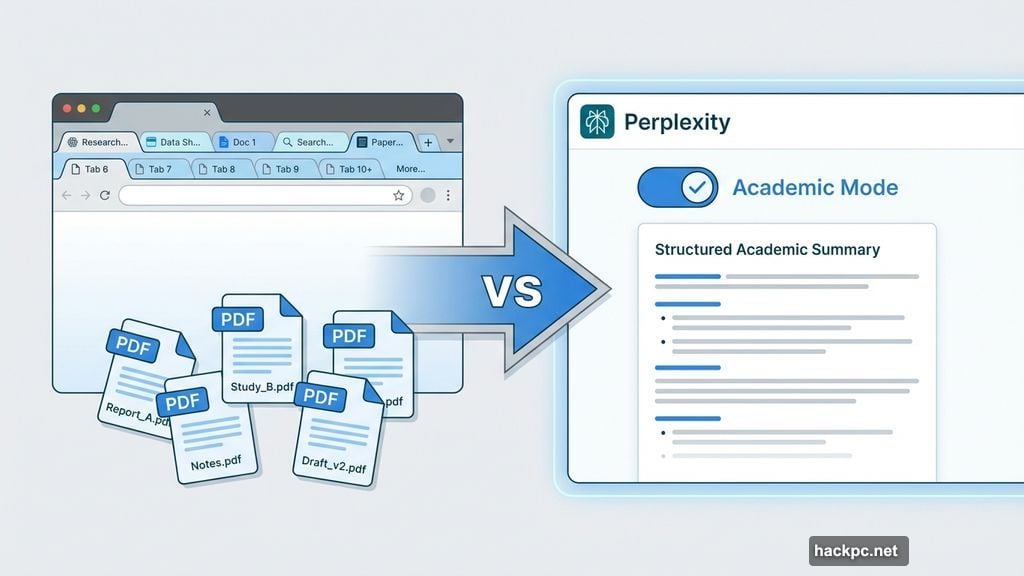
Forget endless browser tabs and scattered PDFs. One AI platform now handles deep research across journals, papers, and academic databases without the usual chaos.
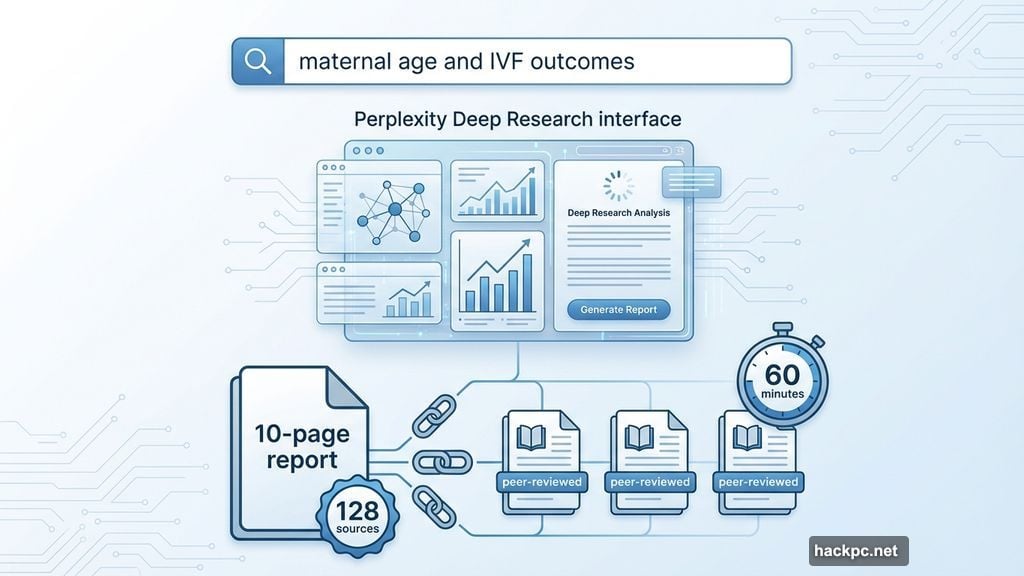
I tested Perplexity‘s Academic mode while researching fertility science for a story. What normally takes hours of manual digging through studies took about 60 minutes. Plus, I found information I’d never encountered in months of prior research.
Here’s what makes this different from just asking ChatGPT random questions.
Academic Mode Changes Everything
Most AI chatbots pull from general web sources. That’s fine for quick facts. But terrible for serious research.
Perplexity’s Academic mode filters out everything except scholarly databases, journals, and peer-reviewed publications. So you’re not wading through blog posts and Reddit threads when you need actual science.
I toggled off web sources entirely. Then I asked about maternal age and IVF outcomes. The tool generated a 10-page report citing 128 academic sources. All hyperlinked. All relatively recent publications.
This would’ve taken me half a day to compile manually. Instead, I got it in minutes.
The Setup Takes About Two Minutes
Head to Perplexity’s website and log in. The free version gives you limited queries. Pro costs $15 monthly and removes those limits while adding access to newer AI models.
Select the Deep Research tab. Then choose your source type. Web is pre-selected, but Academic is where the magic happens for serious work.
That’s it. You’re ready to research.
Real Research Reveals Surprising Findings
As a journalist covering fertility technology, I needed to understand why pregnancy after 35 gets labeled “geriatric.” Does age still matter if you use genetically normal embryos?
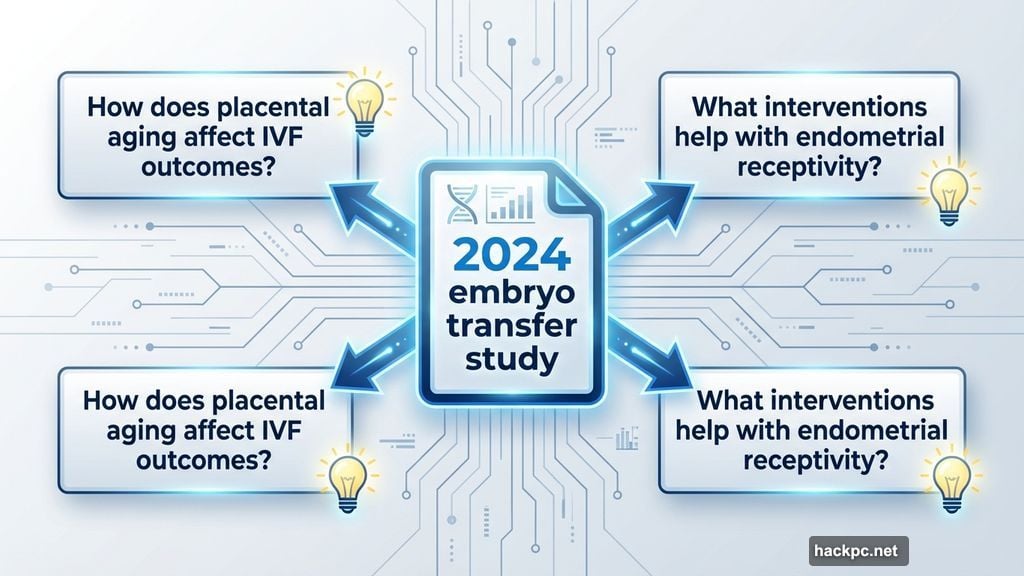
Perplexity pulled studies I hadn’t seen before. One 2024 paper showed that personalized embryo transfer protocols help older women achieve the same success rates as younger women when using normal embryos.
That contradicted what I thought I knew.
Another finding: IVF success drops sharply at 38, not 35 like conventional wisdom suggests. Plus, the research introduced me to “placental aging” as a distinct factor. I’d never encountered that term in months of prior fertility research.
The tool also revealed that placental aging appears more frequently in IVF pregnancies specifically. That’s a story angle right there.
Follow-Up Prompts Guide Deeper Exploration
After the initial report, Perplexity suggested related questions. Things like “How does placental aging affect IVF outcomes?” and “What interventions help with endometrial receptivity in older women?”
These prompts helped me explore adjacent topics I hadn’t considered. It’s like having a research partner who anticipates your next question.
I asked about placental aging directly. The tool explained it’s not a brand new concept, but recent research has characterized it more precisely. Apparently, the placenta undergoes accelerated aging in assisted reproduction pregnancies.
Fascinating. And actionable for my story.
Citations Actually Check Out
Here’s the critical part. I spent 10-15 minutes verifying sources.
The references were legitimate academic journals. Publication dates ranged from 2020 to 2024. No sketchy sources or misrepresented findings that I could spot.
But you absolutely must click those hyperlinks and verify. AI tools hallucinate. They misinterpret studies. They sometimes cite papers that don’t say what the AI claims they say.
So treat Perplexity like a research assistant who does the initial legwork. Then you verify their work before relying on it.
Free Version Has Serious Limitations
I only got one Deep Research query on the free tier. That’s barely enough to evaluate the tool properly.
For students or professionals who need regular access, the Pro subscription makes sense. Fifteen dollars monthly isn’t cheap. But it’s cheaper than most academic database subscriptions.
Plus, you can download reports as PDFs. That’s useful for sharing with colleagues or keeping records of your research process.
Where Perplexity Beats Manual Research
Speed matters. What takes hours manually takes minutes here.
The tool surfaces connections between studies you might miss. It draws conclusions across multiple papers and presents them coherently. That synthesis work alone saves massive time.
Academic mode also filters out junk sources automatically. No more wading through predatory journals or non-peer-reviewed publications.
And the interactive format makes research less tedious. You can follow curiosity trails without losing your place.
Where Manual Research Still Wins
Critical evaluation. You need to verify everything yourself.
Perplexity can misinterpret study conclusions. It might miss important caveats or limitations in the research. It definitely can’t assess whether a particular study’s methodology was sound.
So use it for discovery and initial synthesis. Then do the hard work of actual analysis yourself.
Also, browsing academic databases manually sometimes reveals unexpected connections. Algorithms optimize for relevance. But breakthroughs often come from tangential discoveries.
This Changes How I Approach Story Research
I’m a journalist who typically spends hours digging through studies for health-related articles. Perplexity just compressed that timeline dramatically.
But more importantly, it helped me find research I’d have missed. That 2024 study on personalized transfer protocols? I never would’ve discovered it through my usual methods.
The tool makes academic research more accessible and interactive. That’s legitimately valuable for anyone working with complex information.
Just remember it’s an assistant, not a replacement for critical thinking. Verify everything. Question the conclusions. Follow up on sources that seem important.
Do that, and you’ve got yourself a research tool that actually delivers on the AI hype.




Comments (0)