
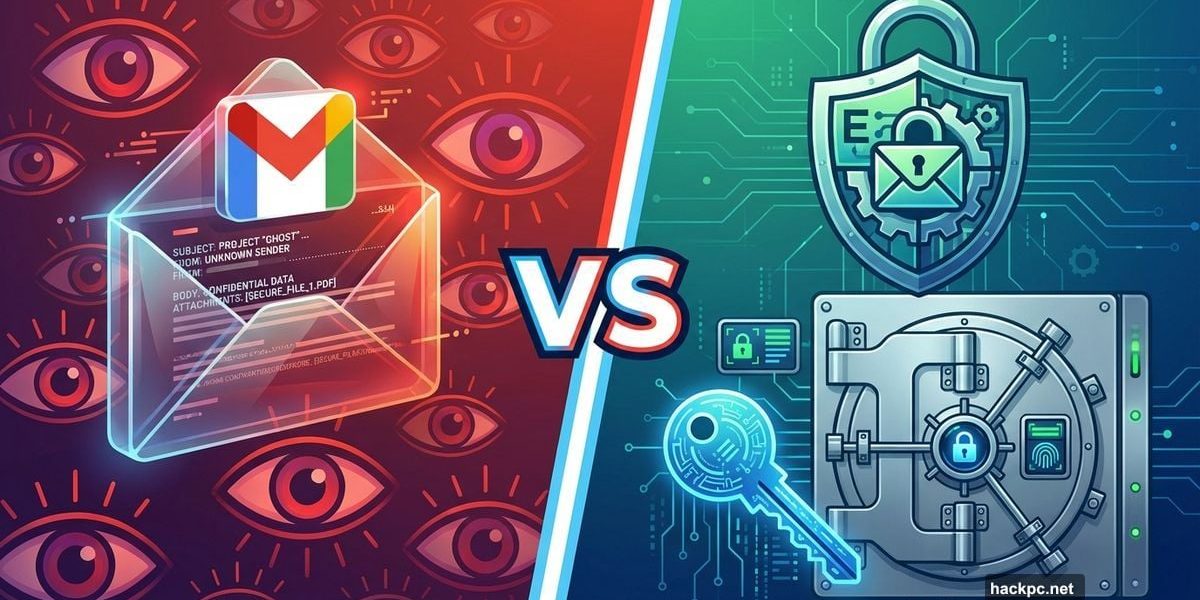
Your inbox holds medical records, financial statements, and private conversations. Standard email providers can technically read every word.
That’s not paranoia. That’s how traditional email works. Companies like Gmail scan messages to improve features, target ads, and comply with legal requests. Plus, if hackers breach their servers, your emails become an open book.
Encrypted email services flip this model entirely. They lock down your messages before they reach company servers. So even the provider can’t decrypt your content. Let’s explore why this matters for your digital security.
Zero-Access Encryption Changes Everything
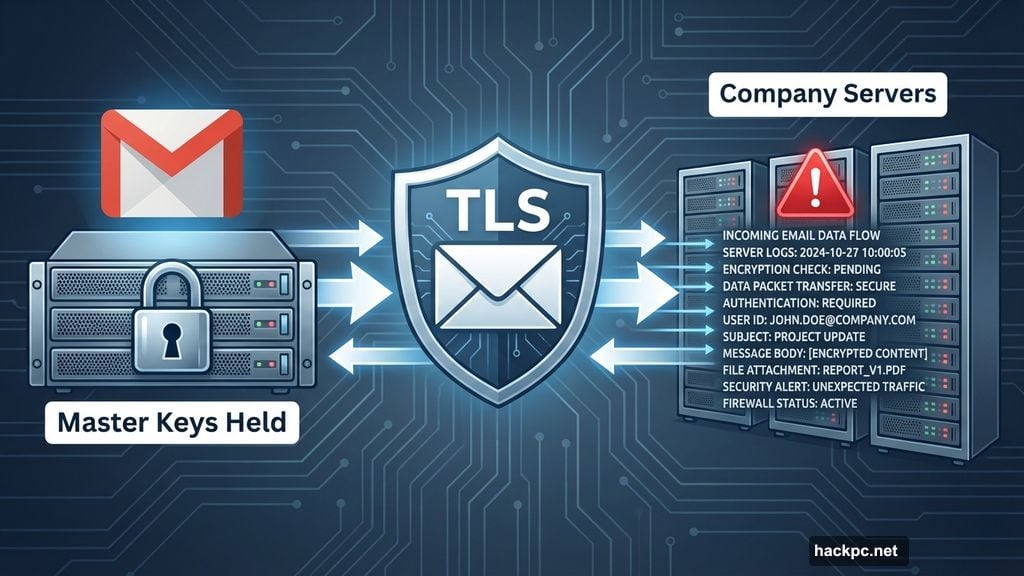
Standard providers protect emails during transmission using TLS encryption. Great. But once messages reach their servers, those companies hold the master keys.
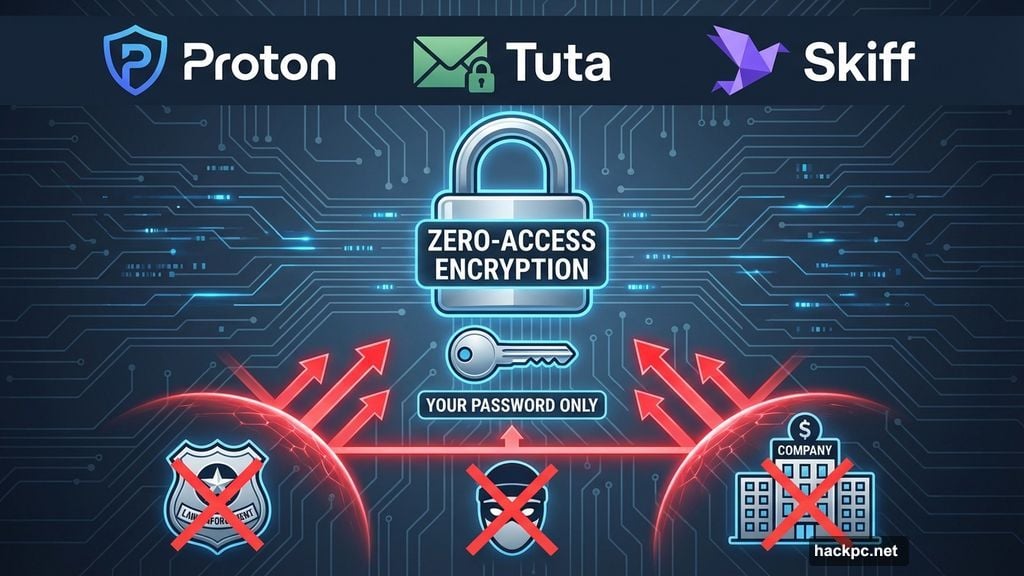
Encrypted services like Proton, Tuta, and Skiff use zero-access encryption instead. Your password becomes the only key that unlocks your data. The email provider never sees readable text.
Here’s what this means in practice. If a government demands access to your emails, the provider can hand over only encrypted gibberish. Without your password, nobody can read those messages. Not law enforcement. Not hackers. Not even the company itself.
This approach dramatically reduces what security experts call “single points of failure.” Traditional email systems concentrate risk at the provider’s servers. Encrypted services distribute that risk to individual users who control their own keys.
Phishing Attacks Meet Their Match
Cybercriminals love email. It’s their primary attack vector for stealing credentials and distributing malware.
Encrypted email services build in defenses that standard providers often skip. Digital signatures verify sender identity automatically. This makes sophisticated phishing attacks much harder to pull off.
Moreover, message tampering becomes obvious. If someone intercepts and alters an encrypted email during transmission, the digital signature breaks. Recipients instantly know the message was compromised.
Standard email offers no such protection. Attackers can spoof sender addresses and modify messages without leaving traces. You might think an email came from your bank when it actually originated from a criminal’s laptop.
Plus, encrypted services typically strip tracking pixels and block external images by default. These features prevent marketers and attackers from confirming your email address is active and monitoring when you open messages.
Server Breaches Become Less Catastrophic
Large email providers make juicy targets for hackers. Millions of accounts live on centralized servers.
When breaches happen and they do the damage can be massive. Yahoo suffered the largest email breach in history. Attackers stole data from 3 billion accounts. That’s not a typo. Billion with a B.
Encrypted services limit breach damage dramatically. If hackers gain server access, they find only encrypted data. Without individual user passwords, stolen information remains unreadable.
This doesn’t eliminate all risks. Hackers might install keyloggers or compromise endpoints. But it removes the single most valuable target from the attack surface. Your old emails don’t become instant trophies for criminals.
Traditional providers can’t offer this protection. They need access to your readable emails to provide features like search, smart replies, and spam filtering. That access creates inherent vulnerability.
Compliance Gets Simpler for Professionals
Healthcare workers handle patient records. Lawyers manage privileged communications. Financial advisors discuss sensitive investments.
Sending this information through standard email creates legal liability. Regulations like HIPAA, GDPR, and various financial privacy laws mandate strict data protection.
Encrypted email services help professionals meet these requirements. Many providers design their systems specifically for regulatory compliance. They offer features like access controls, audit trails, and data retention policies.
This proactive approach demonstrates due diligence. If regulators investigate, you can show concrete steps taken to protect sensitive information. That matters when fines for data breaches can reach millions of dollars.
Plus, clients notice. Receiving encrypted messages signals that you take privacy seriously. This builds trust and differentiates your services in competitive markets.
The Trade-Off Nobody Mentions
Encrypted email isn’t perfect. You give up some convenience for enhanced security.
Search becomes less powerful. Providers can’t index your messages on their servers because they can’t read them. Some services offer client-side search, but it’s slower and requires downloading messages to your device.
Smart features take a hit too. Gmail’s auto-replies and category sorting rely on analyzing message content. Encrypted providers can’t offer these features the same way without compromising security.
Account recovery gets trickier as well. If you forget your password with Gmail, recovery is straightforward. With encrypted email, your password is the only key. Lose it, and your messages become permanently inaccessible. Some services offer recovery options, but they introduce security trade-offs.
These limitations aren’t bugs. They’re features. The whole point of zero-access encryption is that nobody except you can read your messages. That includes helpful AI assistants.
When Standard Email Still Makes Sense
Not everyone needs military-grade email encryption. If you mainly exchange casual messages and don’t handle sensitive data, standard providers might suffice.
Gmail and Outlook offer legitimate advantages. Better integration with other services. More powerful spam filtering. Larger storage capacity. These features matter for everyday use.
Plus, encrypted email only works when both parties use it. If you send an encrypted message to someone with a Gmail account, the protection breaks at their end. Their provider can still read the message once they decrypt and reply.
This creates a network effect problem. Encrypted email provides maximum benefit when everyone in your communication circle uses it. That’s a high bar for most people.
Making the Switch
Ready to try encrypted email? Start with a free account from Proton or Tuta. Use it alongside your existing email for sensitive communications.
Test the experience. See if the security benefits outweigh the convenience trade-offs for your needs. You don’t have to make an all-or-nothing decision.
Many professionals maintain two addresses. One encrypted service for sensitive client work. One standard account for general correspondence. This hybrid approach balances security and usability.
Just remember your password. Seriously. Write it down somewhere secure. Store it in a password manager. Because if you lose access to an encrypted email account, nobody can help you recover it. Not customer support. Not clever hackers. Nobody.
That’s exactly the point. Your privacy stays yours. Even from the people running the servers.


Comments (0)