
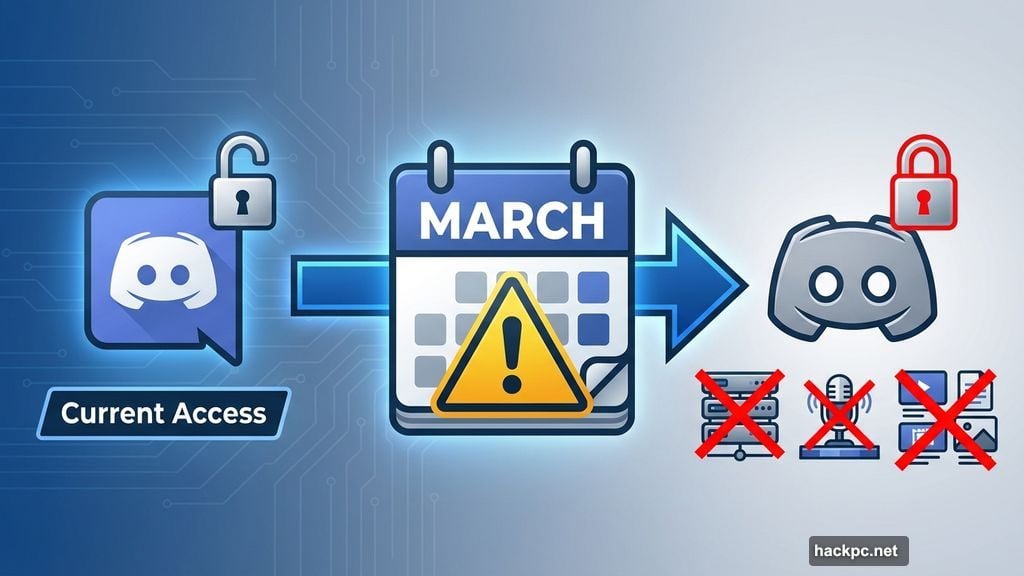
Discord just dropped a bombshell. Starting in March, every user gets treated like a teenager until they prove otherwise.
The chat platform will lock down accounts by default with strict content filters and access restrictions. Want full access back? You’ll need to scan your face or submit government ID photos. No exceptions.
This marks Discord’s biggest privacy shift yet, affecting over 200 million active users worldwide.
What Actually Changes for Unverified Users
Discord isn’t messing around with its new default restrictions. If you skip verification, here’s what you lose.
Age-restricted servers become completely invisible. The platform covers them with a black screen until you verify. You can’t read messages, view content, or participate at all. Even servers you joined years ago get hidden behind this wall.
Stage channels disappear too. These livestream-style audio rooms won’t let unverified users speak or participate. Plus, all graphic or sensitive content gets filtered automatically, whether you want that protection or not.
Your DMs get reorganized as well. Messages from unfamiliar users land in a separate inbox automatically. Friend requests from unknown accounts trigger warning prompts before you can accept them.
Two Verification Methods, Neither Ideal
Discord offers two paths to prove you’re an adult. Both raise privacy concerns.
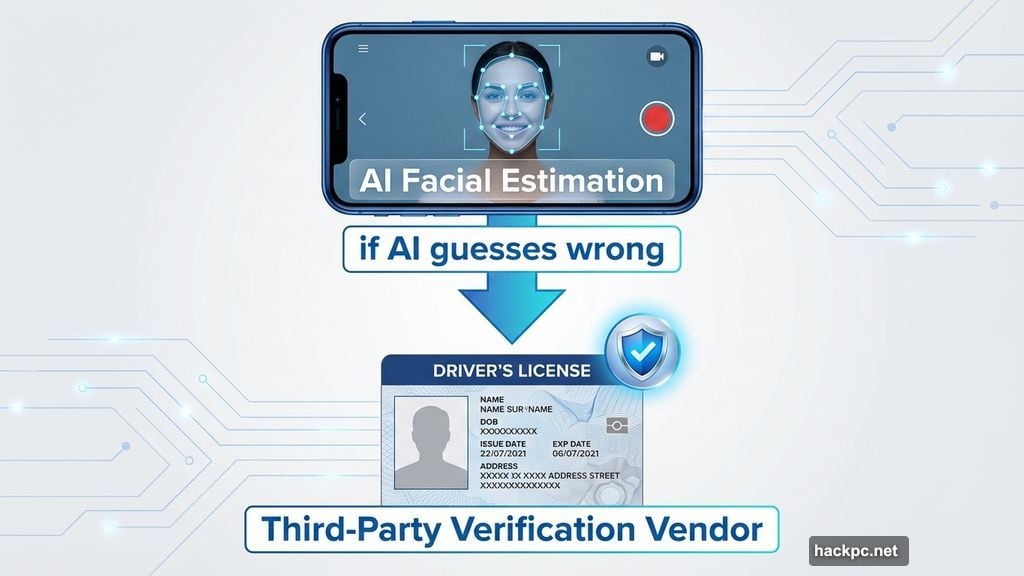
The first option uses AI facial estimation. You record a quick video selfie that analyzes your facial features to guess your age group. Discord claims this video never leaves your device. But if the AI guesses wrong, you’re forced into the second option anyway.
That second path requires uploading a government ID photo. Driver’s license, passport, birth certificate – Discord accepts various documents through third-party verification vendors. The company promises these images get deleted immediately after verification. But promises aren’t guarantees.
Here’s the uncomfortable part. Discord suffered a data breach last October that exposed user verification data, including ID photos. The breach happened through a third-party vendor Discord no longer uses. Still, the incident proves these systems aren’t bulletproof.
Savannah Badalich, Discord’s global head of product policy, emphasized the company switched vendors after the breach. She stressed that facial estimation doesn’t use biometric scanning or facial recognition. Just age grouping. But that distinction might feel meaningless to users worried about data security.
The Hidden Third Option Most Users Won’t See
Discord built a sneaky workaround for users who hate both verification methods. It’s called age inference, and it happens automatically behind the scenes.
The platform analyzes your Discord behavior to guess if you’re an adult. What games do you play? When are you active? How much time do you spend chatting? These signals feed into a model that assigns confidence scores.
If Discord feels confident you’re an adult based on this metadata analysis, you skip verification entirely. Badalich says most users won’t notice any changes because of this system. But here’s the problem – you don’t control whether Discord applies this to your account.

The platform decides for you based on opaque criteria. That lack of transparency bugs privacy advocates. Plus, behavior analysis raises its own surveillance concerns, even if it avoids face scans and ID uploads.
Why This Rollout Feels Rushed
Discord tested age verification in the UK and Australia last year. Users immediately found creative workarounds. One viral method used Death Stranding’s photo mode to fake facial scans.
Discord patched that loophole within a week. But Badalich admits users will keep finding new tricks. The company expects to spend significant effort fighting verification bypasses after the global launch.
That admission reveals something important. Discord knows its system has holes. Yet it’s rolling out globally anyway, driven by legal pressure more than technical readiness.
International regulations are forcing platforms to implement age checks faster than they can perfect the technology. The UK’s Online Safety Act, Australia’s age verification laws, and similar legislation worldwide created this rush.
Discord isn’t alone. Meta, YouTube, and other platforms face the same pressure. But being part of a trend doesn’t make rushed implementation less concerning.
The User Exodus Nobody Wants to Discuss
Badalich acknowledged something most companies avoid admitting. Discord expects to lose users over this change.
Some adults will refuse verification on principle. Privacy-conscious users won’t trust another platform with their face data or government IDs. Especially after the October breach showed these systems can fail.
Others will leave because age-restricted content disappears from their experience. Discord’s definition of “truly adult content” remains vague. That ambiguity means servers could get locked behind verification walls without clear warning.
The company says it’s “incorporating that into planning” and will “find other ways to bring users back.” Translation: They know some departures are permanent but hope new features can offset the losses.
But here’s the uncomfortable truth. Discord built its early community partly on lax moderation and minimal restrictions. Tighter age gates fundamentally change what made the platform appealing to many users. You can’t easily undo that cultural shift.
The Privacy Dilemma No Solution Fixes
This rollout exposes a fundamental conflict in modern internet design. Protecting minors requires age verification. But age verification requires surrendering privacy in ways that make adults uncomfortable.
Facial estimation sounds less invasive than ID uploads. Until you remember that training AI models requires massive datasets of faces. Where does that training data come from? Who controls it? These questions lack clear answers.
ID verification seems straightforward but creates honeypots of sensitive data. Even with immediate deletion promises, images pass through vendor systems that become breach targets. The Discord October incident proved that risk is real, not theoretical.
Age inference through behavior tracking avoids both problems. But replaces them with constant surveillance of your activities. Every game you play, every hour you’re online, every chat pattern gets analyzed to build confidence scores about your age.
None of these options respect privacy the way early internet users expected. Yet regulatory pressure makes them unavoidable. Discord chose the least bad options from a menu of bad choices.
What Comes Next for Age Verification
Discord’s global rollout sets a precedent other platforms will follow. If it succeeds without massive user backlash, expect similar systems across social networks, gaming platforms, and content sites.
Badalich mentioned “more options coming in the future” for verification methods. That suggests Discord knows current solutions don’t satisfy users. But what alternatives exist? Decentralized identity systems? Blockchain-based age proofs? Those technologies aren’t ready for mainstream deployment.
The real question is whether governments will accept less invasive verification methods. Or whether legal requirements will keep pushing platforms toward more intrusive checks. Current regulatory trends point toward the latter.
Users caught in the middle face an uncomfortable choice. Accept verification and trust platforms with sensitive data. Or get locked out of content and features they’ve used for years. Neither option feels fair. But fairness isn’t driving these decisions – legal compliance is.
Discord’s March rollout will test whether users value privacy enough to leave or convenience enough to comply. My guess? Most will reluctantly verify. Not because they trust the system. But because they can’t easily replace the communities they’ve built on the platform.
That’s the real power platforms wield. Once you’ve invested years in a community, switching costs become prohibitively high. Discord knows this. So do regulators. The question is whether anyone will prioritize user choice in this equation.
Probably not.



Comments (0)