
YouTube Music quietly started locking lyrics behind its paywall. Free users now get five songs, then nothing but blurred text.
This isn’t new territory. Spotify pulled the same move in 2024. Users revolted so hard that Spotify backed down within weeks. So why is Google trying the exact same strategy that already failed for its biggest competitor?
Five Songs, Then Pay Up
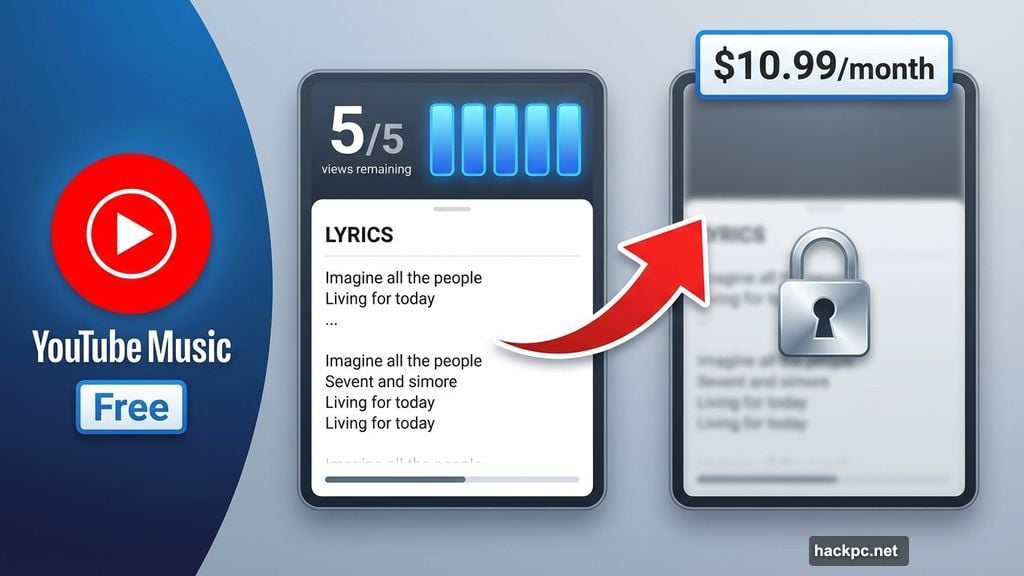
The change hit without warning. Free users who open the “Lyrics” tab now see a counter: “You have [x] views remaining. Unlock lyrics with Premium.”
Once you burn through those five songs, lyrics disappear. Instead, you get a preview of the first few lines, then blurred text. Want to sing along? Fork over $10.99 monthly.
Plus, this wasn’t a sudden decision. Google tested the feature with select users since at least September 2024, according to earlier reports. That means they watched Spotify’s lyric paywall disaster unfold in real-time and decided to do it anyway.
Musixmatch Might Be the Real Villain
Here’s the thing nobody’s saying out loud. YouTube Music doesn’t write these lyrics. They license them from companies like Musixmatch, which aggregates lyrics from publishers and copyright holders.
Those licensing deals cost real money. Every time you view lyrics, Google pays a fraction of a cent to the rights holders. Multiply that by millions of free users, and the costs add up fast.
So from Google’s perspective, they’re bleeding money on a feature that doesn’t drive Premium subscriptions. The solution? Make lyrics exclusive to paying customers. Simple math, terrible optics.
But Spotify faced identical economics. Their licensing costs didn’t magically disappear when users complained. Yet they found a way to keep lyrics free after the backlash. That suggests the costs aren’t actually prohibitive—just annoying enough to use as leverage.
Spotify Already Proved This Backfires
Remember when Spotify tried this exact playbook? February 2024. They locked lyrics behind Spotify Premium. Free users could still see them, but only for three songs per month.
The reaction was brutal. Social media exploded with complaints. Music forums filled with anger. Users threatened to switch to YouTube Music—which offered free lyrics at the time.
Spotify caved within weeks. They brought back unlimited lyric access for free users. The PR damage wasn’t worth whatever money they saved on licensing fees.
Now Google is walking the same path. Either they think their users won’t react as strongly, or they believe their market position is strong enough to weather the storm. Both assumptions seem questionable.
The Premium Push Gets Aggressive
YouTube Music Premium costs $10.99 monthly. Same price as Spotify, Apple Music, and Amazon Music. The pitch includes ad-free playback, offline downloads, background play, and AI features.
But here’s the problem. Most users tolerate ads and skip AI features. They just want to listen to music and occasionally check lyrics. For that use case, free YouTube Music worked fine until now.
Moreover, YouTube Music competes in a crowded field. Spotify dominates with superior playlists and discovery. Apple Music integrates seamlessly with iOS devices. Amazon Music bundles with Prime subscriptions.
So YouTube Music’s main advantage was being “good enough” while free. Taking away lyrics removes one of the few reasons casual users stick around instead of switching to competitors.
Google Hasn’t Confirmed Anything Yet
Despite widespread reports and user complaints, Google hasn’t officially announced the change. That suggests this might still be a limited test rather than a permanent rollout.
However, the scale of recent reports indicates the test expanded significantly. Users across different regions and device types are seeing the paywall. That pattern suggests Google is preparing for a full launch, not pulling back.
The silence is strategic. If backlash builds like it did for Spotify, Google can claim this was “just a test” and reverse course without admitting failure. If users accept it quietly, they can make it permanent without explaining the decision.
Classic corporate move. Test controversial changes, gauge reaction, then decide whether to commit or retreat.
Why This Matters More Than You Think
Lyrics seem like a minor feature. But they represent something bigger: the slow erosion of free features in streaming music.
First, platforms removed offline downloads for free users. Then they limited skips. Now lyrics are joining the paywall club. Each change individually seems reasonable. Together, they make free tiers nearly unusable.
Plus, this affects how people discover music. Lyrics help non-native speakers understand songs. They assist hearing-impaired users. They let casual listeners engage more deeply with music without committing to subscriptions.
Taking that away doesn’t just hurt free users. It makes music less accessible across the board.
Free Users Will Probably Lose This Fight
Here’s the uncomfortable truth. Free users don’t pay the bills. Premium subscribers do.
Spotify has 236 million Premium subscribers and 381 million free users. But Premium generates virtually all their revenue. The free tier exists mainly to convert users into paying customers.
So when platforms choose between keeping free users happy and pushing them toward subscriptions, the financial incentive is obvious. Annoying free users until they pay works better than making the free tier comfortable.
YouTube Music follows the same logic. They’d rather lose some free users than keep subsidizing lyrics for people who might never subscribe anyway.
That doesn’t make it right. But it explains why Google is willing to try this despite Spotify’s earlier failure. The long-term bet is that enough users will convert to Premium to offset whoever leaves.
Your Move, Google
YouTube Music could still reverse this decision. Spotify did. The backlash was loud enough and fast enough that keeping lyrics free became the smarter business move.
But Google operates differently than Spotify. They have YouTube’s massive user base and advertising revenue to fall back on. They don’t depend on music subscriptions the same way Spotify does.
That financial cushion might make them less responsive to user complaints. Or it might give them room to experiment with pricing strategies Spotify can’t afford to try.
Either way, free users are the lab rats. The next few months will show whether Google learned from Spotify’s mistake or decided to repeat it anyway.


Comments (0)