
Your Windows PC deserves better privacy protection. Whether you’re streaming Netflix from abroad, downloading torrents, gaming online or just browsing without your ISP watching every move, a good VPN makes a real difference.
But with dozens of options out there, picking the right one feels overwhelming. So we did the heavy lifting. After running more than 250 speed tests per provider, checking for DNS leaks and testing streaming unblocking across dozens of services, here are the best VPNs for Windows right now.
ExpressVPN Leads the Pack on Windows
ExpressVPN earns the top spot for good reason. It combines class-leading privacy, fast speeds and excellent streaming unblocking in one polished package.
The Windows app is genuinely easy to use. Whether you’ve never touched a VPN before or you’re a seasoned privacy pro, you’ll feel at home within minutes. Plus, that same smooth experience carries over to Android, iOS, MacOS, Apple TV and even Linux with a graphical interface.
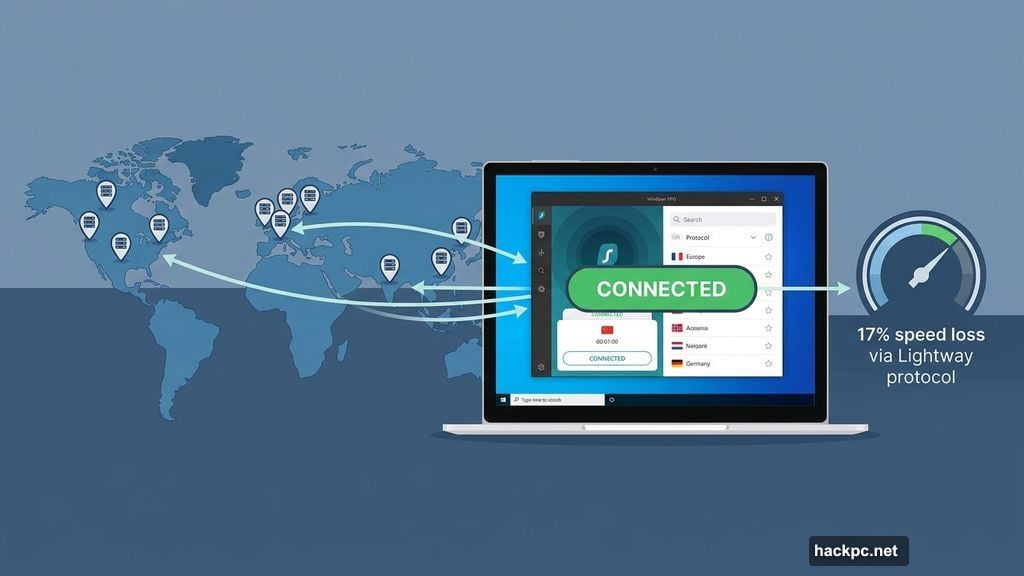
Speed-wise, ExpressVPN recorded an 18% average download speed loss in 2025 testing. On Windows specifically, that was 17% over the Lightway protocol and 18% on OpenVPN. Both numbers are well within the “you won’t notice” range for streaming, gaming and torrenting.
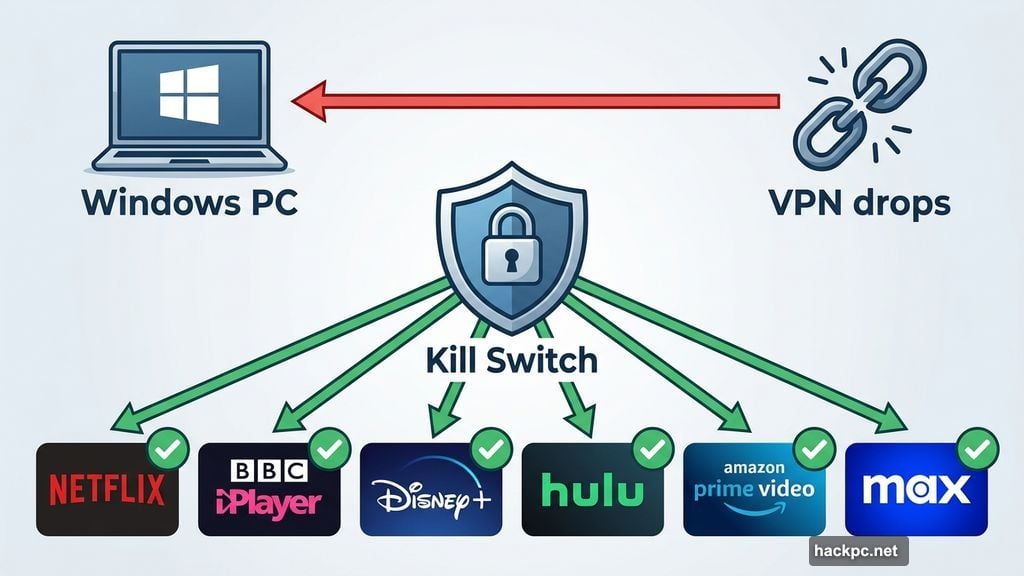
Streaming performance is outstanding. During testing, ExpressVPN unblocked Amazon Prime Video, BBC iPlayer, Disney Plus, Hulu, Max and Netflix without a hitch. And as of July 2025, ExpressVPN covers all 50 US states with servers, making it a strong pick for catching regional sports like NFL, WNBA and NWSL matches from anywhere.
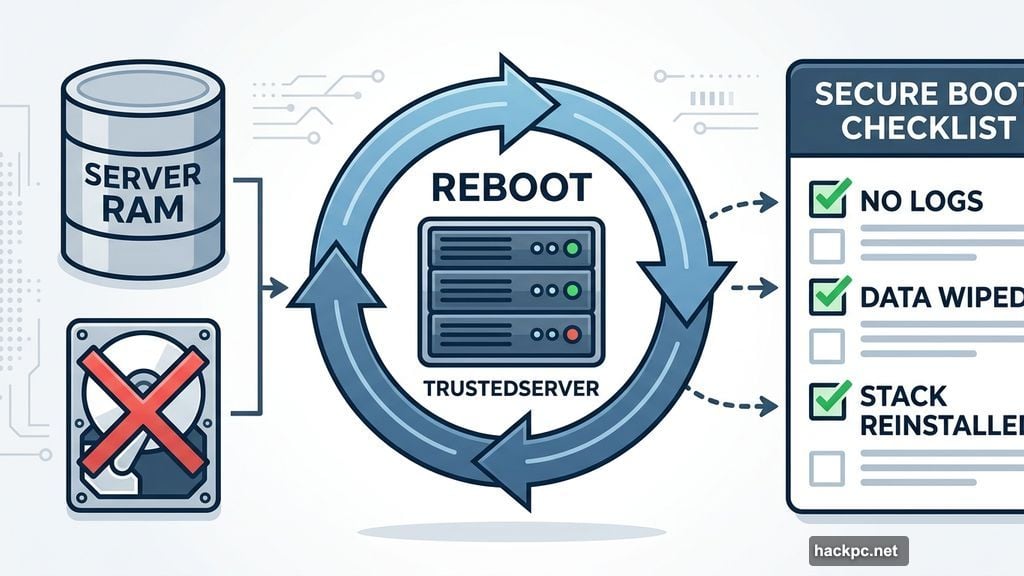
Privacy is where ExpressVPN truly shines. The company has completed 23 independent audits since 2018, which is more than any competitor. Its TrustedServer technology wipes all data and reinstalls the entire server stack on every reboot. The kill switch works as advertised, no leaks were detected in testing and the new IP Shuffle feature quietly rotates your IP address with every new webpage you load.
ExpressVPN also supports Windows Arm devices, so Copilot Plus PCs like the Microsoft Surface Pro are covered. The Arm app is still in beta, though, so a handful of features like split tunneling aren’t available yet.
The one real drawback? Price. At $13 per month or $75 for the first 15 months (renewing at $100 per year), ExpressVPN sits at the premium end. A seven-day free trial and 30-day money-back guarantee let you test it risk-free before committing.
CNET Score: 9/10
Surfshark Wins on Value
Surfshark delivers a premium VPN experience without the premium price tag. For most Windows users, it hits the sweet spot between features, speed and cost.
The Windows app is clean and intuitive, and that same quality extends across platforms including Android TV, Apple TV, Fire TV, iOS, Linux and MacOS. Streaming support is excellent. During testing, Surfshark unblocked Amazon Prime Video, BBC iPlayer, Disney Plus, Hulu, Max and Netflix with minimal issues across devices and platforms.
Speed performance is solid. Surfshark averaged 21% download speed loss overall in 2025, with 23% on Windows using WireGuard and 25% on OpenVPN. Neither number should cause noticeable buffering on a decent connection. And unlike ExpressVPN or NordVPN, Surfshark offers unlimited simultaneous connections, meaning you can run it on every device you own under one subscription.
Surfshark’s feature list includes some standout privacy tools. Dynamic Multihop lets you chain two server locations for an extra layer of protection. Rotating IP switches your address every few minutes. Alternative ID even generates a fake name, address and email for signing up to services without exposing your real details.
Post-quantum protections are now live too, putting Surfshark in line with ExpressVPN, Mullvad and NordVPN on future-proofing your encryption against quantum computing threats. Windows Arm support is included, though the antivirus feature isn’t available on Arm devices yet.
Surfshark operates under Dutch jurisdiction, which sits within the 14 Eyes intelligence-sharing alliance. That’s worth noting if you have particularly sensitive privacy needs.
Pricing has climbed recently. The yearly plan costs $48 for the first year but renews at $99, which is a significant jump. Still, even at renewal, it undercuts NordVPN’s $140-per-year renewal rate.
CNET Score: 8.6/10
NordVPN Is the Fastest Option
If raw speed matters most to you, NordVPN has no real competition. Its 3% average download speed loss in 2025 testing is genuinely remarkable. The nearest competitor, Proton VPN, came in at 16%.
On Windows specifically, NordVPN recorded just 11% speed loss using NordLynx (its WireGuard-based protocol) and 21% on OpenVPN. Those numbers translate directly into buttery-smooth 4K streaming, fast torrent downloads and low-latency gaming sessions. NordVPN unblocked Amazon Prime Video, BBC iPlayer, CBC Gem, Crunchyroll, Disney Plus, Hulu, Max and Netflix during testing.
Beyond speed, NordVPN offers a 7,400-plus server network spread across 118 countries, which edges out ExpressVPN and Surfshark on global reach. Ten simultaneous connections should cover most households with ease.
Privacy features go well beyond the basics. NordWhisper is a proprietary obfuscation protocol that disguises VPN traffic as standard web browsing, which comes in handy on restrictive networks like school Wi-Fi. Double VPN runs your connection through two servers instead of one. Onion over VPN layers Tor on top for maximum anonymity. Meshnet creates a private virtual network for secure file sharing or streaming without multi-factor authentication headaches.
NordVPN’s Windows Arm support stands out from competitors. As of March 2025, the full app released for Arm devices with complete feature parity to the x86 version. That means split tunneling and even the Threat Protection antivirus work properly on devices like the Surface Pro.
The pricing catch is significant. NordVPN starts at $13 per month or $60 for the first year, but renews at $140 annually. That’s the highest renewal price among the top four providers and well above ExpressVPN’s $100 or Proton VPN’s $84 annual renewal.
CNET Score: 8.8/10
Proton VPN Is the Best Free Option
Most free VPNs are genuinely bad. They sell your data, show you ads, cap your bandwidth or come bundled with malware. Proton VPN breaks that pattern completely.
The free tier includes unlimited monthly bandwidth, no advertising and no data collection. The main restrictions are that you can only connect one device at a time, access servers in 10 countries and can’t manually pick a specific server. For basic privacy needs, that’s often enough.
Proton’s paid plan is a genuine contender against NordVPN, Surfshark and Mullvad. You get access to 18,100-plus servers across 129 countries, which is the largest network of any VPN we tested. Speed is impressive too, with a 16% average download speed loss, second only to NordVPN. On Windows, that was 25% on WireGuard and 21% on OpenVPN.
The Stealth protocol, now available on Windows, disguises your VPN traffic as regular HTTPS. That’s particularly useful for bypassing censorship, using school or workplace Wi-Fi that blocks VPNs or traveling to countries with restrictions on VPN use.
Streaming support is outstanding. Proton unblocked virtually every service tested, including Netflix Egypt, which only a handful of VPNs manage to crack. Proton also offers a fully native Windows Arm app with complete feature parity to the desktop version, making it an excellent pick for Copilot Plus device users.
Proton recently refreshed the Windows app’s interface, bringing it closer to the redesigned Android app. The new profiles feature lets you create one-touch connection presets with your preferred location, protocol, ad blocker settings and auto-launch website already configured.
One gap worth knowing: Proton lacks 24/7 live chat support, though the company plans to add it by end of year. Also, a design flaw in the MacOS app could expose your public IP when switching servers. A fix is reportedly on the way.
At $10 per month, $42 for the first year or $72 for two years (renewing at $84 annually), Proton’s paid plan offers solid value, especially compared to NordVPN’s aggressive renewal pricing.
CNET Score: 8/10
WireGuard, OpenVPN and Obfuscation Protocols Explained
Choosing the right VPN protocol on Windows affects both speed and privacy. It sounds technical, but the basics are straightforward.
WireGuard is the go-to choice for most people. It’s fast, secure and efficient. NordLynx (NordVPN’s version) and Lightway (ExpressVPN’s version) are both WireGuard derivatives built for even better performance. Surfshark and Proton VPN use standard WireGuard. For everyday browsing, streaming or gaming, any of these will serve you well.
OpenVPN is older and slower but rock-solid and battle-tested. Some VPN experts prefer it for situations where maximum compatibility and security matter more than speed. It also handles obfuscation better than WireGuard in some scenarios.
Then there are obfuscation protocols. NordVPN’s NordWhisper and Proton VPN’s Stealth both disguise your VPN traffic as normal web traffic. These come into their own when you’re on a network that blocks VPNs, traveling to countries with internet restrictions or just want your ISP to see nothing unusual in your traffic.
AES-256-bit encryption covers OpenVPN and IKEv2 connections. ChaCha20 handles WireGuard. Both are effectively uncrackable with current computing power. Post-quantum protections, now available from ExpressVPN, NordVPN, Surfshark and others, add a layer of defense against future quantum computing threats.
Split Tunneling, Kill Switches and Other Features Worth Knowing
A kill switch sounds dramatic but does a simple job: if your VPN connection drops unexpectedly, it immediately cuts your internet access so your real IP address never gets exposed. All four of our top picks include a kill switch, and all four passed our testing.

Split tunneling lets you choose which apps go through the VPN and which bypass it. This is genuinely useful. For example, you can run BBC iPlayer through a UK server while downloading a Steam game at full speed outside the VPN tunnel. NordVPN and Surfshark both offer split tunneling on x86 Windows. ExpressVPN’s Arm app is still missing it in beta.
DNS leak protection keeps your browsing activity hidden from your ISP even if something goes wrong with your VPN connection. All four providers handle this correctly. No leaks were detected during CNET testing.
Double VPN and Tor over VPN offer extra anonymity layers for users with serious privacy concerns. NordVPN offers both. They slow your connection significantly but provide meaningful protection for journalists, activists or anyone operating in a high-risk environment.
How VPN Speed Affects Streaming and Gaming
Netflix recommends at least 15Mbps for a single 4K UHD stream. So your VPN-reduced speed needs to stay above that threshold after the slowdown kicks in.
If you start with 100Mbps internet and use NordVPN (3% speed loss), you’ll still have around 97Mbps. That’s more than enough for anything. Surfshark’s 21% loss still leaves you with 79Mbps on that same connection. Even Proton VPN’s 16% drop keeps you at 84Mbps.
Gaming adds latency to the equation. Download speed matters less for online gaming than ping, which measures how fast data travels between your machine and the game server. VPNs always add some latency. The best approach for gaming is using split tunneling so your game client bypasses the VPN entirely, while other apps on your PC stay protected.
If you do need a VPN for gaming, pick a server close to your actual location or the game server, use WireGuard or an equivalent fast protocol and stick with a provider that consistently delivers low speed loss.
Windows Arm Support: What Copilot Plus PC Owners Need to Know
Copilot Plus PCs running Arm processors, like the Microsoft Surface Pro with Snapdragon X Elite or X Plus chips, need Arm-compatible apps. Traditional x86 VPN apps don’t run natively on these devices.
NordVPN has the strongest Arm support right now. Its full Windows Arm app launched in March 2025 with complete feature parity, including split tunneling and Threat Protection antivirus. Proton VPN also offers a fully native Arm app with all desktop features intact.
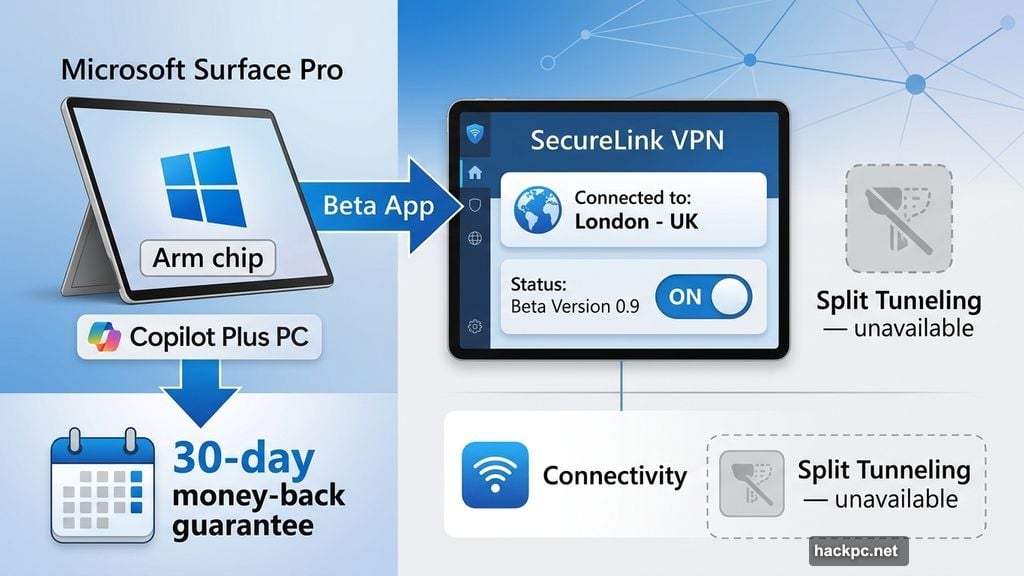
ExpressVPN and Surfshark both have Arm apps but are still working through feature gaps. ExpressVPN’s Arm app lacks split tunneling for now. Surfshark’s Arm version is missing the antivirus engine. Both companies are actively developing updates.
Free VPNs vs Paid Plans: The Honest Picture
Free VPNs are almost always a bad deal. Most make money by selling user data to advertisers or data brokers. Some have been found carrying malware. Many impose bandwidth caps so tight they’re barely usable.
Proton VPN is the only free VPN we wholeheartedly recommend. It doesn’t sell data, doesn’t run ads and doesn’t cap bandwidth. The trade-off is limited server access and no manual server selection.
The best way to try premium VPNs for free is through their money-back guarantees. ExpressVPN, NordVPN and Surfshark all offer 30-day guarantees. ExpressVPN adds a seven-day free trial on top. If you cancel within the window, you get a full refund.
For budget-conscious users, annual plans offer the best value without the risk of long commitments. Two- and three-year plans come with bigger discounts, but the VPN industry changes fast. A provider that looks great today could get acquired or suffer a data breach. Sticking to an annual plan limits your exposure.
Which Windows VPN Should You Choose?
For most people, ExpressVPN is the safest all-around pick. It nails privacy, delivers fast speeds and unblocks virtually everything. Yes, it costs more, but the consistency and transparency are worth it.
If budget matters, Surfshark gets you 90% of ExpressVPN’s experience at a meaningfully lower price, especially in that first year. Unlimited device connections are a bonus if you have a lot of gadgets.
Speed obsessives and power users will love NordVPN. Nothing touches its 3% average speed loss, and the fully native Arm app is the best in class right now. Just brace yourself for the renewal price.
And if you want to try a VPN for free without any catches, Proton VPN is the one to start with. The free tier is surprisingly capable, and the paid upgrade path is genuinely excellent.
Whichever you pick, you’ll browse more privately, stream without borders and keep your ISP out of your business.



Comments (0)