
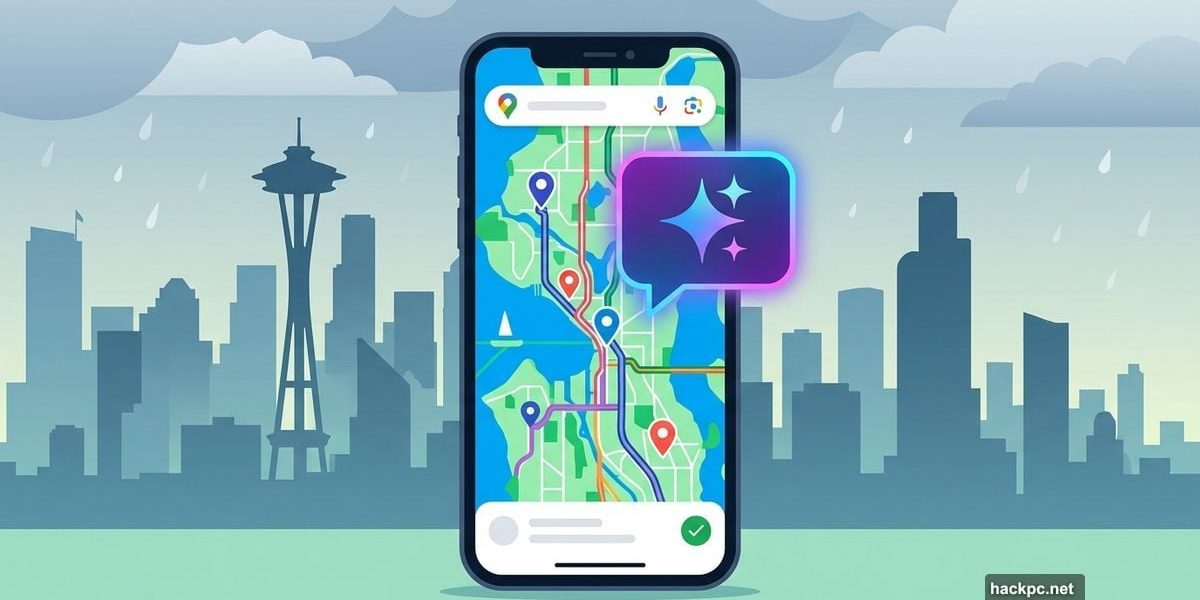
Spoiler: it never once told me to walk into a river.
Google has been stuffing Gemini into every product it makes. Gmail, Search, Drive — you name it. But Maps is one of its newer additions, and honestly? It might be the most useful one yet.
I decided to put it to a real test. I asked Gemini to plan a full day out in Seattle using public transit. Lunch, a walk, a coffee shop, two neighborhoods, home by 4:30. Let’s see what an AI travel planner can actually do.
“Ask Maps” Is Not What I Expected
If you haven’t used it yet, Gemini lives inside Google Maps as a feature called “Ask Maps.” Tap it and you get a familiar chatbot interface. Ask it anything about your surroundings and it pulls from Google Maps data — user reviews, business info, hours — plus outside sources when needed.
Ask about weather before a cross-town trip? It checks the forecast for you. Ask for a kid-friendly taco spot with good vibes? It digs through reviews to find one. It’s basically a very helpful friend who has read every Google Maps review ever posted.
I gave it my parameters: public transit only, lunch first, then a walk, then a laptop-friendly coffee shop. Two neighborhoods. Home by 4:30. Go.
Tacos, Plants, and Cardamom Buns
Its first suggestions were almost embarrassingly on-brand for me. A cafe next to a bookstore. A reliable downtown coffee shop. Two places I’d literally just been. So we went back and forth a bit, and eventually landed on something better: tacos, a botanical conservatory, and a Scandinavian-inspired coffee shop.
Tacos Chukis was first. I’d heard of it but never made it there. The place is tucked into the back of a building with zero sidewalk signage, but Gemini steered me right to it. It also tipped me off that the house specialty with grilled pineapple was popular. Three excellent tacos later, I understood why.
Next up was Volunteer Park Conservatory — basically a big greenhouse in the middle of Seattle. Gemini suggested it as a dry option since it was absolutely pouring outside. Smart call. The place costs $6 to get in (which Gemini failed to mention, minor complaint), but it’s a warm, quiet little oasis. One of the staff members spotted me gawking at the cacti and insisted on taking my photo next to the largest one. Seeing a cactus up close is genuinely strange and kind of mystical, like spotting an owl in the wild.
The One Hallucination That Could Have Wrecked Everything
Here’s where things got interesting. Between the tacos and the conservatory, I was ahead of schedule and asked Gemini to suggest a quick shop nearby. It confidently recommended Elliott Bay Books — a genuinely great bookstore — but described it as “one block east.”
It was not one block east. It was a solid 10-minute walk in the completely wrong direction.
I was standing in the rain, laptop in my backpack, umbrella barely holding on. That bad piece of AI-generated directions could have seriously derailed the afternoon. After I pointed this out, Gemini corrected itself and sent me to Kobo instead — a small shop selling beautiful Japanese goods that I didn’t even know had a location nearby. So it recovered well, but the hallucination was a real reminder that LLM (large language model) navigation requires some healthy skepticism.
Worth noting: when it came to actual transit directions — getting from stop to stop — Gemini didn’t freestyle those. It handed me off to Google Maps’ standard transit routing, which uses real-time data. Smart design decision.
![A person in a rainy Seattle street using Google Maps on their phone to navigate to a coffee shop, with Gemini’s AI suggestions visible on screen]
The Coffee Shop It Recommended Was Perfect (Even Without the Cardamom Bun)
Last stop was Day Made Kaffe. Gemini described it as minimalist but warm and laptop-friendly. That sounded exactly right, even though I’d somehow never heard of the place despite spending plenty of time in that neighborhood.
Walking in, I realized I actually had been there before. Back when it was a fancy home goods store where I bought Christmas gifts in 2024. Funny how that works.
The coffee was excellent. The vibes were exactly what Gemini promised. The cardamom bun it specifically recommended wasn’t available that day, so I pivoted to a guava pastry instead. Zero regrets. I left the shop at 3:40 as Gemini had suggested, caught my last bus, and walked through my front door at 4:26 PM.
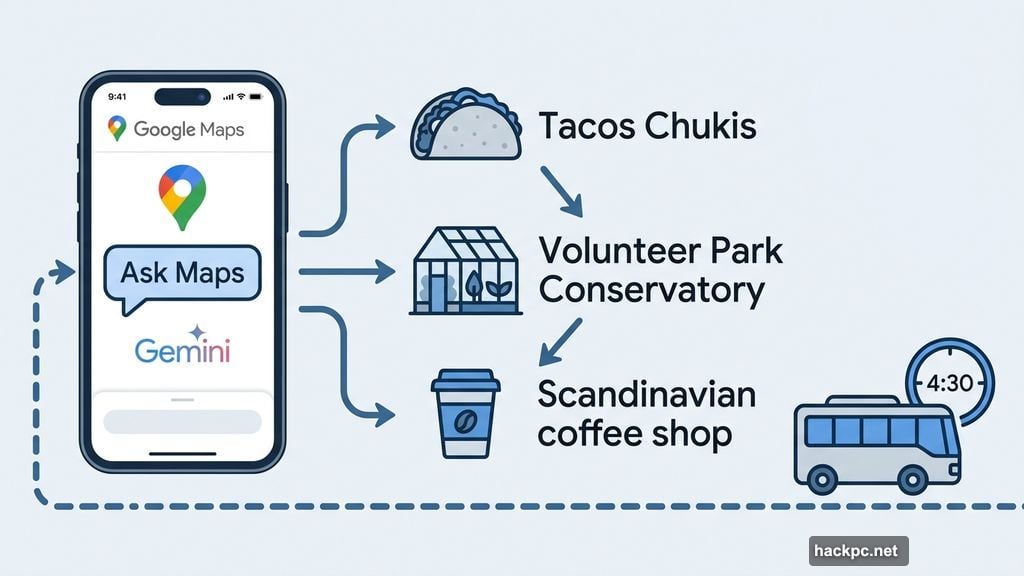
Nailed it.
What Gemini Is Good At (And Where It Leans on Humans)
Here’s the thing worth saying clearly: the best parts of my day happened because real people wrote great reviews. Gemini is the middleman, not the source of truth. It just helps you search a massive, often overwhelming dataset much faster than you could on your own.
That’s genuinely useful. Google Maps holds an enormous amount of information about local businesses, and Gemini lets you filter it in natural language. Want a restaurant that’s both kid-friendly and has good cocktail options? You can search dozens of reviews across a whole neighborhood in seconds instead of tapping around for 20 minutes.
It also does a decent job of showing its reasoning as it makes suggestions. You can usually see where its recommendations are coming from, which builds a little trust — even when it gets things wrong.
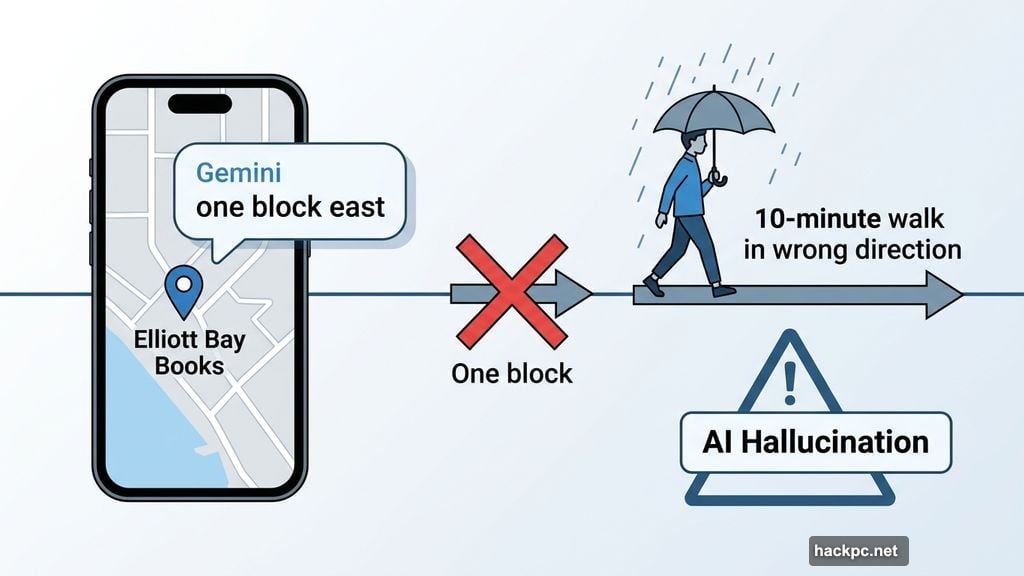
But hallucinations are a real concern when you’re counting on an AI to guide you through the physical world. A wrong bookstore recommendation in the pouring rain is annoying. The same mistake on a tight schedule or in an unfamiliar city could be genuinely frustrating.
![Gemini’s Ask Maps chat interface showing an itinerary suggestion with lunch, a park visit, and coffee shop stop in Seattle]
Should You Use Gemini in Google Maps?
If you’re the kind of person who spends too long staring at the map trying to pick the “right” place — and trust me, I am absolutely that person — Gemini is a surprisingly good shortcut. It’s not magic. It gets things wrong sometimes, and you should double-check anything location-critical before you commit to walking somewhere in the rain.
But as a planning tool? It’s genuinely fun to use. I found spots I wouldn’t have found on my own, got steered into a conservatory I’d walked past a dozen times without going inside, and made it home with four minutes to spare.
Day made, indeed.




Comments (0)