
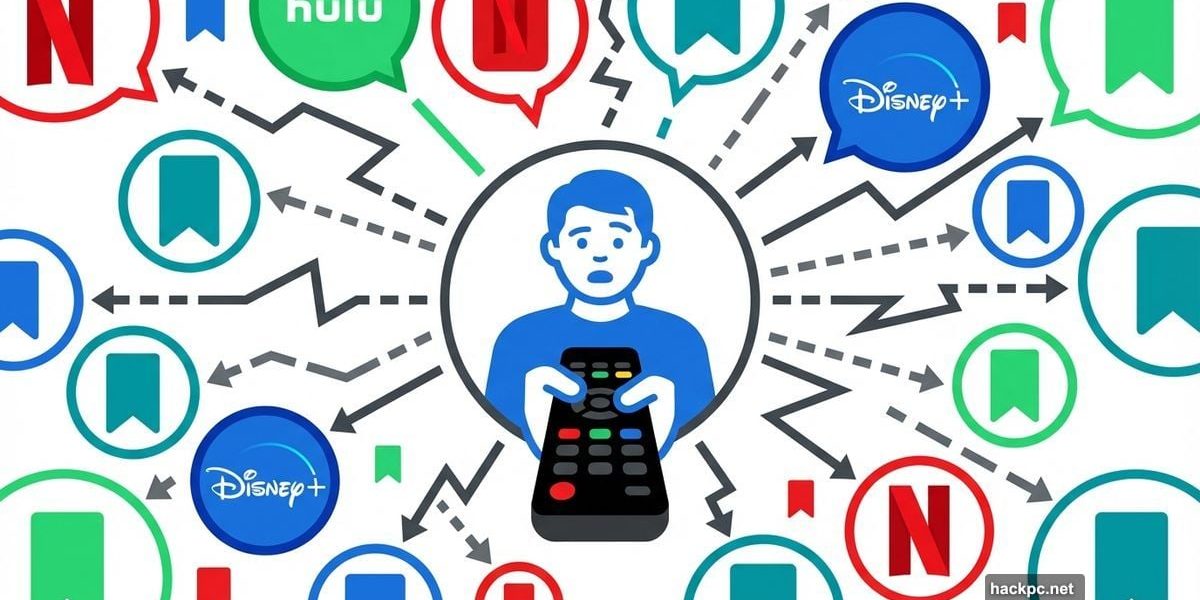
Your family probably maintains about a dozen different watch lists right now. You just don’t realize it yet.
Think about it. There’s your Netflix profile watch list. Your partner’s Hulu queue. The kids accidentally bookmarked something on Tubi. Google TV has its own separate collection. Plus whatever’s sitting in that smart TV platform you barely remember setting up.
Finding anything you actually wanted to watch? Good luck with that.
The Watch List Problem Nobody’s Solving
Watch lists seemed brilliant when streaming services first rolled them out. See something interesting at 11PM? Hit that bookmark button. Come back later when you’re ready.
But that was before we all juggled five or six streaming subscriptions. Now those convenient bookmark features created isolated data silos scattered across every app and platform.
Here’s a typical scenario. You browse Netflix late at night and bookmark a documentary. Tomorrow, your spouse finds a show on Hulu and adds it to their profile. Except they were accidentally logged into your kid’s account. So that show lives on a watch list nobody will ever check again.
Meanwhile, your smart TV platform maintains its own universal watch list. Completely separate from everything else. Plus, some streaming apps refuse to share data with TV platforms at all. Netflix won’t let Google TV users add titles to their smart TV watch list.
The result? Your bookmarked content sits fragmented across a dozen different lists. Most families have no idea which service holds that movie they’ve been meaning to watch for months.
Universal Watch Lists Don’t Actually Work
Some apps try fixing this problem. Plex maintains a decent universal catalog of titles across major streaming services. Their watch list tracks favorites from multiple platforms in one place.
The execution falls short though. When you discover something interesting on Netflix at midnight, you can’t just bookmark it. Instead, you grab your phone. Open the Plex app. Search for that same title. Add it manually. Then do the whole process again later to remove it after watching.
That’s exhausting. Nobody wants to manage their entertainment like a part-time job. So people abandon universal watch lists and fall back to whatever’s easiest. Which means more fragmentation and more forgotten bookmarks.
Smart TV deep links create another headache. Mobile apps handle them well enough. But TV platforms? Results vary wildly depending on your hardware. Roku users get especially unlucky here.
Federation Could Actually Solve This
Streaming services need to open their watch list data. Not completely. Just enough to sync between platforms when users opt in.
Picture this instead. You bookmark a movie on Netflix. The Netflix app automatically shares that data with your Plex watch list. Watch the movie later? It disappears from both lists simultaneously. Your spouse adds a Hulu show to Google TV? That show instantly appears in your Hulu watch list too.
You could bookmark content anywhere and consume those bookmarks anywhere else. One master list maintained by Plex, Google, or another service. But every streaming app stays synchronized in real time.
Netflix might never list Hulu exclusives. Fair enough. But shows regularly jump between services these days. What if Netflix tracked shows you bookmarked on HBO Max? Then automatically added them to your Netflix list when those HBO shows eventually migrated over?
Federation would make profiles less critical too. Sure, you and your partner have different tastes sometimes. But most TV watching happens together. So why not automatically sort bookmarked content by genre, mood, and age rating? Instead of trapping everything in profile-specific silos?
The Cool Stuff Federation Enables
Shared watch list data unlocks possibilities that don’t exist today. Spotify could automatically generate playlists from soundtracks of movies and shows you recently watched. Based on titles disappearing from your watch list.

Recommendation engines could get smarter across platforms. Your Netflix viewing history could help Hulu suggest better content. And vice versa. The more data flowing between services, the easier it becomes to find something perfect for tonight.
Third-party developers could build interesting tools. Maybe an app that tracks which streaming service has the best value based on your actual watch list. Or alerts when bookmarked titles go on sale for permanent purchase.
Right now? None of this happens. Streaming services guard their data obsessively.
Why Netflix and Others Resist Sharing
Netflix wants you living inside their app exclusively. They don’t want third-party aggregators recommending Hulu titles based on your Netflix viewing patterns. They definitely don’t want Google TV building universal features that pull users away from the Netflix experience.
That protective approach explains why Netflix blocks Google TV integration. It’s also why exactly one major streaming service offers RSS feeds for watch lists. Just Plex. Everyone else keeps that data locked down tight.
The logic makes sense from a business perspective. But it creates terrible user experiences. Consumers don’t benefit from artificial data barriers. They just end up with forgotten bookmarks scattered across apps they barely remember using.

Open the Floodgates Already
Streaming executives love talking about user experience. Here’s a concrete way to improve it dramatically.
Free the watch list data. Let users opt into sharing between services. Ingest as much information as possible from other platforms. Use it to help people find perfect content without searching a thousand fragmented lists.
Build APIs that let developers create interesting tools. Maybe someone invents a brilliant watch list interface nobody’s thought of yet. You won’t know unless you open those floodgates.
Federation worked for email decades ago. It transformed social media recently with Mastodon and Bluesky. The same principle could revolutionize streaming entertainment. Competing services can still compete on content and features. Just stop trapping user data in pointless silos.
Until that happens? Consumers suffer needlessly. We maintain redundant lists. We forget great content we actually wanted to watch. We waste time searching for bookmarks that should be instantly accessible.
Streaming services could fix this tomorrow. They just need one executive willing to take the first step. Maybe someone looking for a New Year’s resolution that actually helps customers.
Otherwise, I might abandon watch lists entirely. Crack open a book instead. Now if I could only remember what I wanted to read next.



Comments (0)