

AI music tools promised to help artists create. Instead, Suno is quietly enabling something far more troubling — a pipeline for flooding streaming platforms with AI-generated knockoffs of real songs, and the filters meant to stop it barely put up a fight.
Suno’s official policy says it doesn’t allow copyrighted material. You can upload your own tracks, remix your own work, or set original lyrics to AI-generated music. Sounds reasonable. But investigative testing by The Verge’s Terrence O’Brien reveals the copyright detection system is remarkably fragile. With a free audio editor and a few minutes, anyone can generate eerily convincing AI covers of Beyoncé, Black Sabbath, and Aqua — close enough to the originals that casual listeners might mistake them for alternate takes or rare B-sides.
Suno declined to comment.
The Filter Bypass Is Shockingly Simple
The workaround doesn’t require any technical wizardry. Suno Studio, available on the $24-a-month Premier Plan, lets users upload audio tracks to edit or cover. If you upload a well-known song directly, the system typically catches and rejects it.
But slow the track to half-speed in Audacity — a completely free, widely available audio editor — and Suno’s filter often misses it. Add a burst of white noise at the start and end, and you’ve basically guaranteed the song slips through. From there, you restore the original speed inside Suno Studio, strip the noise, and the copyrighted song becomes the seed for new AI-generated music.
That’s it. No hacking. No special tools. Just Audacity and a few extra steps.
AI Ozzy and AI Beyoncé Are Unsettling Close
Once the audio clears the filter, Suno’s newer models generate surprisingly convincing imitations. Model 4.5 and 4.5+ reproduce the original instrumental arrangement with minimal changes. Model v5 takes more creative liberties — adding chugging guitar to “Freedom” or turning the Dead Kennedys’ “California Über Alles” into an unexpected fiddle jig.
The vocal mimicry is where things get genuinely uncomfortable. O’Brien found he could bypass the lyrics filter too. Pasting official song lyrics directly from Genius gets flagged and results in gibberish vocals. But change just a handful of spellings — swapping “rain on this bitter love” for “reign on” or “tell the sweet I’m new” to “tell the suite” — and the filter passes the lyrics through. Beyond the first verse and chorus, he didn’t even need to bother with tweaks.
The output summons slightly off-brand versions of Ozzy Osbourne and Beyoncé. Close enough to recognize immediately. Not quite close enough to be the real thing.
Indie Artists Are the Most Exposed
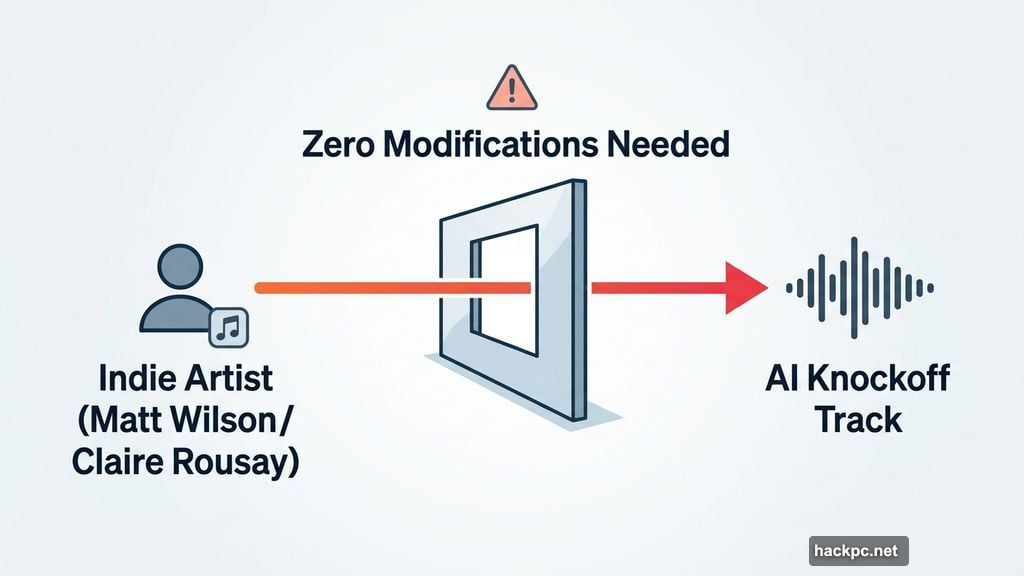
Here’s where it gets genuinely worrying. The testing found that tracks by lesser-known artists cleared Suno’s copyright filter with zero modifications at all. Songs by singer-songwriter Matt Wilson, Charles Bissell’s “Car Colors,” and experimental artist Claire Rousay all passed through without triggering any flags. One of O’Brien’s own songs slipped through too.
Artists distributing through Bandcamp, DistroKid, or CD Baby appear to be the most vulnerable. Neither DistroKid nor CD Baby responded to requests for comment.
Streaming Platforms Face a Flood They Can’t Stop
![A visualization showing AI-generated music files being uploaded to streaming platforms, with copyright warning symbols overlaid on waveforms and album art]
The path from Suno to streaming revenue is disturbingly straightforward. Someone generates an AI cover, exports it, uploads it through a distribution service like DistroKid, and starts collecting royalties — without paying the composers who created the original work a cent. Standard cover song licensing gets skipped entirely.
Folk artist Murphy Campbell learned how badly broken this system is in the most painful way possible. Someone uploaded AI covers of her songs to her own Spotify profile. Then, distributor Vydia filed copyright claims against her YouTube videos and began collecting royalties on them. The songs Vydia successfully claimed? All in the public domain. Spotify eventually removed the fakes, and Vydia rescinded its claims — but only after Campbell launched a social media campaign to draw attention to the situation.
Vydia says the two incidents are unrelated and it has no connection to the AI covers of Campbell’s work.
Campbell isn’t alone. Experimental composer William Basinski and indie rock group King Gizzard and The Lizard Wizard have both had AI imitations slip past multiple filters and land on Spotify. Sometimes these fake tracks siphon streams directly from the real artist’s page. In a system where Spotify requires a minimum of 1,000 streams before paying out anything at all, that kind of diversion hits smaller artists the hardest.
The Music Itself Tells the Story
There’s a certain irony to how these AI covers sound. They’re immediately recognizable — the opening snare of “Freedom,” the riff from “Paranoid” — but completely lifeless. AI Ozzy is alarmingly accurate in tone while lacking any of the nuance or dynamic range that makes the original performance feel human.
The instrumentals follow the same pattern. Pink Floyd’s “Another Brick in the Wall” loses its eerie, doom-disco quality and becomes generic dancefloor filler. A non-jig version of “California Über Alles” has every rough edge sanded away, turning a confrontational punk track into something that sounds like a wedding band playing it safe. The David Gilmour guitar solo in “Another Brick” roughly captures his tone while completely abandoning any sense of phrasing — just a stream of notes with no musical intent behind them.
The AI clearly knows what these songs sound like. It just doesn’t understand why any of the choices were made.
Suno Isn’t Scanning Outputs — Only Inputs
One critical technical detail makes this worse. Suno only appears to scan uploaded tracks at the moment of upload. It doesn’t re-check outputs for potential infringement, and it doesn’t scan tracks again before export. So even if the system somehow caught a bypass attempt mid-generation, nothing stops a finished AI cover from walking straight out the door and onto a distribution platform.
A Broken System With No Easy Fix
Spotify told The Verge it “takes protecting artists’ rights seriously” and uses both automated systems and human review to catch duplicate or highly similar tracks. Spokesperson Chris Macowski acknowledged the challenge directly: “It’s an area we’re continuing to invest in and evolve, especially as new technologies emerge.” Deezer and Qobuz have also taken steps against AI spam and impersonators.
But keeping pace with a tool that makes bypassing copyright filters this easy is a genuine technical challenge, not just a policy one.
Bands can contact Spotify and request removal of AI fakes from their profiles. What they can’t do is easily trace where those fakes originated, or prove which tool generated them. Suno’s response to all of this has been silence.
Independent artists already operate on thin margins in a streaming economy that pays fractions of a cent per play. The last thing they need is an AI platform making it this easy for bad actors to steal their sound, collect their royalties, and face basically no consequences. Until Suno takes this seriously — and does more than offer silence when asked about it — the problem will keep growing.



Comments (0)