
Dozens of Tumblr accounts vanished in a single afternoon this week. No warnings. No clear explanations. Just gone.
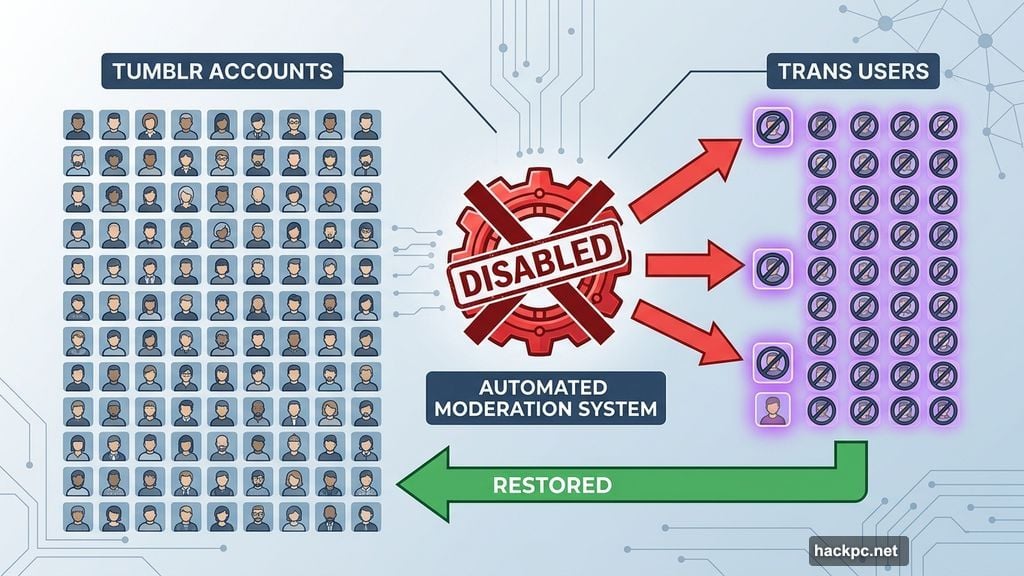
On Wednesday, an automated system swept through the platform and banned a wave of users simultaneously. Many of those users reached out to The Verge, and a troubling pattern emerged quickly. The bans seemed to hit accounts belonging to trans women particularly hard, and most received only a vague email saying automated tools had flagged their content for an “internally-generated report.”
Automattic Confirmed the Bans Were a Mistake
Chenda Ngak, head of communications at Tumblr’s parent company Automattic, confirmed what happened in a statement to The Verge. The good news: many of the bans were wrong, and the company knew it.

“We continuously work to maintain platform health and adapt our systems to prevent bad actors from spreading harm,” Ngak said. “In that process, our automated system has incorrectly flagged several users, including, but not limited to, members of the trans community. We’ve disabled that system and restored those users while we improve it. We sincerely apologize to everyone who was affected by this error.”
So the system is now offline. Affected accounts are being restored. But that doesn’t make the experience any less frightening for the people who lost access to their communities without explanation.
The Timing Made Everything Worse
The mass bans landed just one day after Tumblr reversed a controversial change to its reblogging system. That rollback had already sparked serious user frustration earlier in the week, so naturally people started connecting dots.
Some users who contacted The Verge suspected the bans were retaliation for posts criticizing the reblog change. Ngak pushed back on that idea directly, stating the “terminated accounts are not related to the recent discussion about reblogs.” She also said there is “no evidence that trans users were disproportionately among the sub-200 accounts impacted.”
Still, the timing left a lot of people feeling uneasy. And given Tumblr’s history with moderation and its trans user base, that unease isn’t hard to understand.
A Pattern That Goes Back Years
This isn’t the first time Tumblr’s automated moderation systems have misfired in ways that hurt marginalized communities.
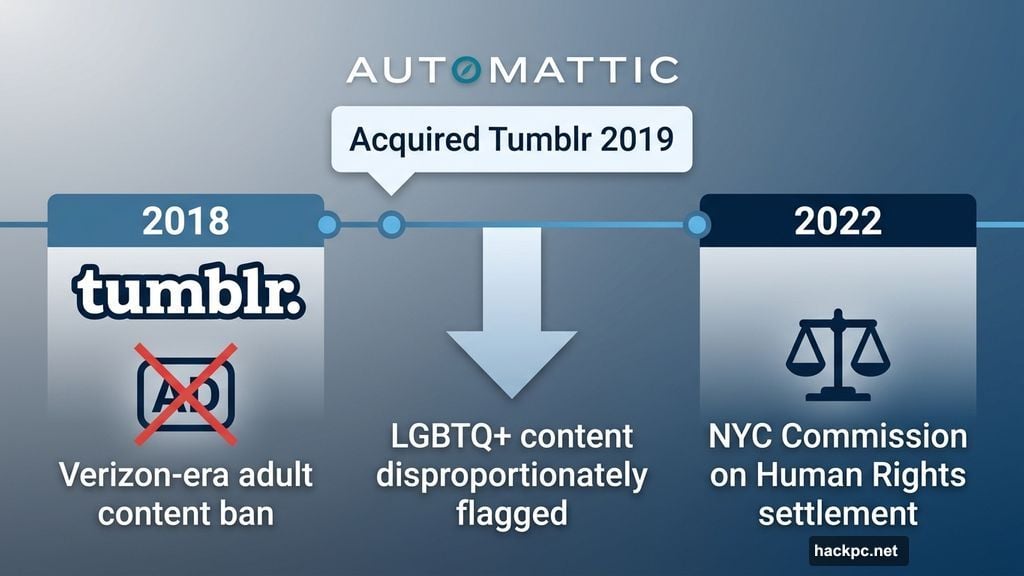
The most notorious example dates back to 2018, when Tumblr banned all adult content on the platform. The system rolled out under previous owner Verizon, before Automattic acquired Tumblr in 2019. Beyond accuracy problems that flagged completely benign content, the ban reportedly hit LGBTQ+ content at disproportionate rates. The fallout was serious enough that in 2022, Tumblr settled with New York City’s Commission on Human Rights over discrimination allegations tied to that ban. The settlement required a full review of Tumblr’s moderation algorithms and forced changes to the user appeals process to address algorithmic bias.
Then there’s the 2024 incident involving Automattic CEO Matt Mullenweg and a trans user named predstrogen. She had been vocal about what she described as a lack of action from Tumblr in response to harassment she was experiencing. After posting frustrated comments that included a heated remark directed at Mullenweg, her Tumblr account was banned. The dispute spilled onto other platforms, where Mullenweg shared private account details including the names of her side blogs.
That situation left a visible mark on how many trans users perceive Tumblr’s relationship with their community.
Automated Moderation Is a Hard Problem, But Users Deserve Better
Here’s what makes situations like this so frustrating. Automated moderation systems exist for legitimate reasons. Platforms the size of Tumblr cannot manually review every piece of content, and bad actors genuinely try to exploit that. So automation makes sense in theory.
But when those systems fail, the consequences fall on real people. Someone loses access to years of posts, relationships, and creative work with no warning and no clear path to getting it back. And when the failures seem to cluster around vulnerable communities, the damage goes beyond inconvenience.
Automattic has been scaling back its investment in Tumblr for a while now. In 2023, Mullenweg confirmed to The Verge that the majority of Tumblr’s non-support, safety, and moderation staff had been moved to other divisions after the platform missed growth targets. That context matters here. A leaner team means more reliance on automated systems, and more automated systems means more chances for exactly this kind of error.
Disabling the faulty system and restoring accounts is the right first step. But it shouldn’t take a wave of panicked users and press coverage to trigger that response. Tumblr’s trans community in particular has been burned too many times by opaque moderation decisions to simply take the company’s word that everything is fine now.
Building trust back requires more than a fix. It requires transparency about what went wrong, how the system will be improved, and what protections will exist to catch similar errors before they reach users. Whether Automattic delivers on that remains to be seen.




Comments (0)