

Webshare offers the lowest proxy prices I’ve seen. Period.
But those rock-bottom rates come with trade-offs. Your requests will complete just fine most of the time. Yet you’ll notice slower response times and higher blocking rates than pricier alternatives like Oxylabs or Decodo.
So who should actually buy Webshare? Anyone prioritizing cost over performance. Let’s break down whether those savings are worth it.
The Price Advantage Is Real
Webshare beats every competitor on pricing across all proxy types. No exceptions.
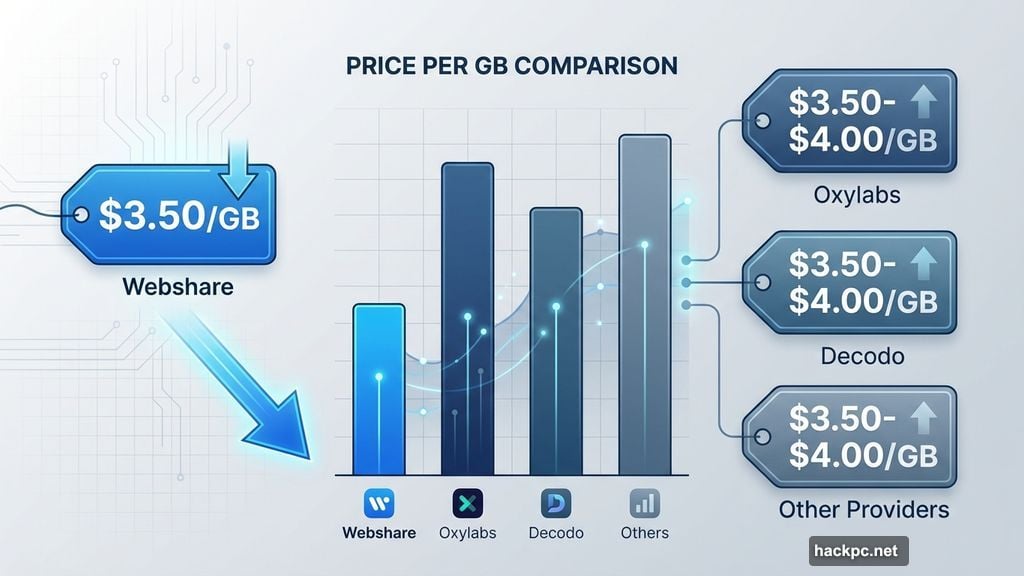
Residential proxies start at $3.50 per GB for small plans. That drops to $1.40 per GB when you buy 3TB monthly. For context, most providers charge $3.50-$4.00 per GB even at high volumes.
Plus, Webshare offers nine different data tiers. Most companies force you into three or four predetermined packages. This flexibility means you pay for exactly what you need instead of overpaying for unused bandwidth.
Data center proxies are even cheaper. Shared data center IPs cost $0.03 per IP for 100 addresses. You also get your first 10 IPs free. I didn’t find anything close to that price elsewhere.
Moreover, annual payments unlock 30% discounts across all plans. So if you commit for a year, those already-low prices drop even further.
Performance Numbers Tell a Different Story
Webshare’s proxies work. But they don’t work as well as top-tier alternatives.
Proxyway’s 2025 research tested millions of requests across major proxy providers. Webshare ranked middle-of-the-pack on most metrics. Not terrible, but not impressive either.
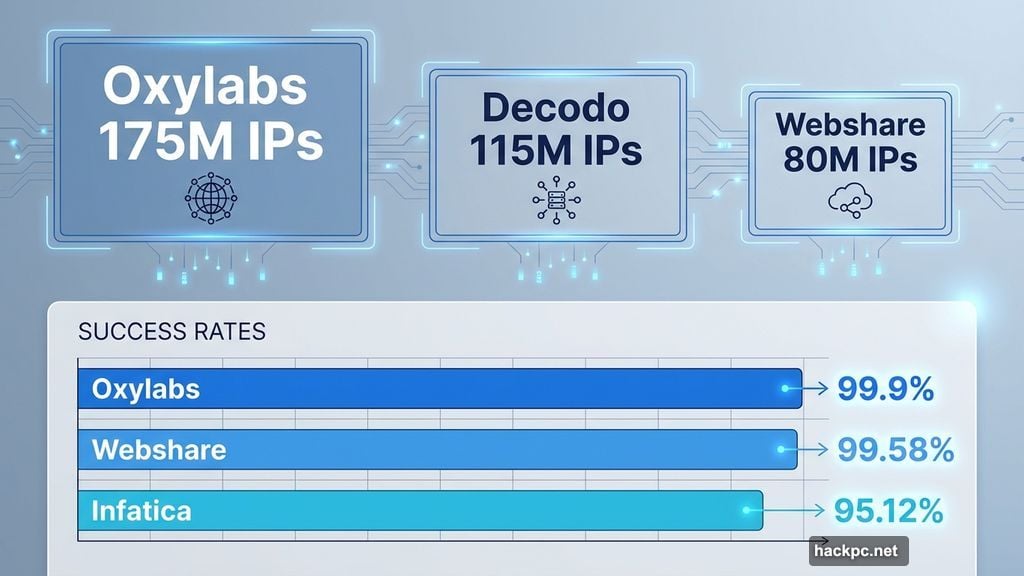
The company maintains 80 million residential IPs. That’s adequate for most use cases. However, Oxylabs has 175 million IPs and Decodo offers 115 million. A deeper pool generally means fewer blocks and more reliable connections.
Infrastructure success rates hit 99.58% overall. That ranked sixth among tested providers. Oxylabs led at 99.9%. Small differences matter when you’re running thousands of daily requests though.
Meanwhile, success rates with popular targets like Amazon, Google and Instagram reached 92.19%. Better than average, landing fourth overall. But still behind Infatica’s 95.12% success rate on those same platforms.
Response Times Lag Behind Competitors
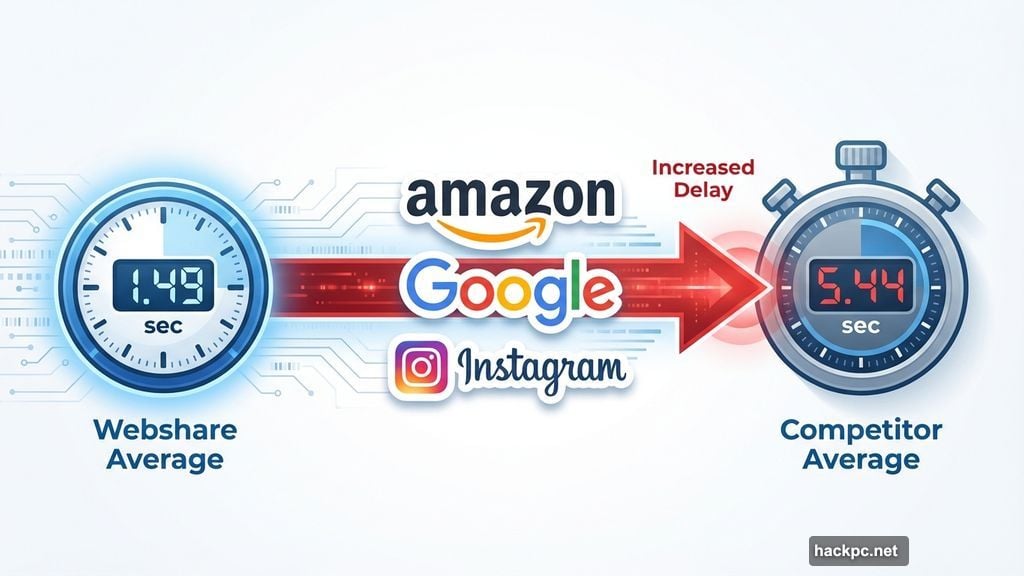
Here’s where Webshare really struggles. Average response times hit 1.49 seconds globally.
That was second-slowest among all tested residential proxy providers. For comparison, the average US internet connection is currently 124 times faster than that.
Response times with Amazon, Google and Instagram were worse. Requests took 5.44 seconds to complete on average. If you’re scraping data from popular sites regularly, that lag adds up fast.
However, my own testing showed more reasonable latency. I connected to residential proxies in Lahore, Seoul and Marseille. Latency stayed under 20 milliseconds consistently.
I also searched for flights on Google through Webshare proxies. The experience felt slightly sluggish at times. But it wasn’t unusably slow. Your mileage may vary depending on target websites and geographic routing.
IP Quality Falls Short of Premium Options
Webshare sources residential IPs ethically. The company defines this as “consenting and fully aware individuals” who join the proxy network for compensation.
Decodo and Oxylabs use similar procurement standards. But ethical sourcing doesn’t automatically equal high quality.
Proxyway uses IPQualityScore to measure fraud risk across proxy pools. This metric predicts how likely IPs are to get flagged as suspicious.
Webshare ranked fifth globally and fourth in the US out of 13 providers. Not bad necessarily. Yet there’s a noticeable gap between Webshare’s fraud scores and top performers like Decodo or Oxylabs.
Higher fraud scores mean more of your requests might get blocked. So you’ll burn through bandwidth faster accomplishing the same tasks compared to cleaner IP pools.
Features Stay Minimal and Straightforward
Webshare skips most developer tools and third-party integrations.
The company lists eight integration guides for tools like proxy browsers and YouTube automation. That’s it. No web scraping APIs. No site unblockers. Few pre-built software connections.
If you’re already using specific data aggregation tools, Webshare probably won’t have native integration. Developers accustomed to robust toolkits will find this limiting.
On the flip side, beginners benefit from the simplicity. The dashboard tracks bandwidth usage, projected depletion dates and error rates clearly. The browser extension lets you connect or disconnect with one click.
You can filter proxies by country and select specific locations easily. Unlike Decodo, you can’t access your data dashboard or manage bypass lists directly in the extension. Any advanced configuration requires visiting the web interface.
Still, connecting to Webshare’s residential proxies was genuinely easy. I set everything up without consulting documentation or support.
Customer Support Responds Quickly
Webshare doesn’t offer phone support. But the live chat connects you with real humans fast.
Initially, the chat shows an AI bot with preset support topics. When I requested human assistance, the bot said someone would respond within a few hours.
Five minutes later, a real representative joined the conversation. They provided detailed answers to my technical questions without canned responses or delays.
Many cheap proxy services skimp on support. Webshare doesn’t. If you hit roadblocks during setup or usage, actual help is available quickly.
Data Center Proxies Offer Extreme Value
Webshare started by selling data center proxies. Those remain some of its best offerings.
Shared data center IPs start at $0.03 per IP for 100 addresses. That’s staggeringly cheap. Oxylabs, Decodo and Brightdata all charge $1.00+ per IP at similar volumes.
However, you sacrifice performance for that price. Webshare’s data center proxies had a 98.61% infrastructure success rate. That ranked seventh out of nine tested providers.
Success rates dropped to 35.92% when limited to Amazon and Google. SOAX’s first-place data center proxies hit 88.5% on those same platforms. So expect significantly more blocks when targeting major sites.
Private data center proxies offer a middle ground. They start at $0.798 per IP for 25 IPs monthly. These IPs are shared between two users maximum, reducing block rates compared to shared options.
Dedicated data center proxies are the premium tier. Only you use these IPs, minimizing blocking risk. Prices start at $1.33 per IP for 20 addresses, dropping to $0.77 per IP at 10,000 IPs.
Static Residential IPs Cost More
Webshare’s static residential proxies (also called ISP proxies) come in private and dedicated tiers.
Private static residential IPs start at $0.93 per IP for 25 addresses. These are shared between two users maximum.
Dedicated static residential proxies begin at $1.33 per IP for 20 addresses. Only you access these IPs. That distinction matters for sensitive use cases where IP reputation is critical.
Both tiers offer 30% discounts on annual payments. If you commit long-term, the effective monthly costs drop significantly.
What Webshare Doesn’t Offer
The company lacks several features found in premium proxy services.
No mobile proxies are available. If your use case requires mobile IPs specifically, you’ll need to look elsewhere.
HTTPS protocol isn’t supported. Neither is SOCKS5 with UDP. Most residential proxy use cases work fine with HTTP and SOCKS5 without UDP. But if you need those specific protocols, Webshare won’t work.
City-level targeting is missing too. You can filter by country but can’t select specific cities. That limits precision for location-dependent testing or scraping.
The proxy pool is ethically sourced but not massive. At 80 million IPs, it’s adequate but not industry-leading. Larger pools generally mean fewer blocks and more routing options.
When Webshare Makes Sense
Buy Webshare if you prioritize cost above everything else. The pricing is genuinely unbeatable across all proxy types.
Small businesses and individual developers benefit most. If you’re scraping data occasionally or testing geo-restrictions, Webshare delivers acceptable performance at minimal cost.
Budget-conscious users who can tolerate slower response times should also consider it. The 1.49-second average latency isn’t ideal. But for non-time-sensitive tasks like batch data collection, it’s perfectly usable.
Projects targeting less-popular websites will see better success rates. Webshare’s performance drops noticeably with major platforms like Amazon and Google. But for mid-tier sites, the success rates are solid.
When You Should Skip Webshare
Avoid Webshare if you need top-tier reliability. The 92.19% success rate with popular targets is good but not great. Infatica hits 95.12% on the same platforms.
Businesses running high-volume operations should look elsewhere too. Those decimal-point differences in success rates compound quickly at scale. You’ll burn through more bandwidth accomplishing the same work.
Time-sensitive applications won’t tolerate the latency. If you’re running real-time monitoring or need sub-second response times, Webshare’s 5.44-second delays with major platforms are dealbreakers.
Mobile proxy requirements automatically disqualify Webshare. The company simply doesn’t offer them.
Projects requiring HTTPS or SOCKS5 with UDP need different providers. Webshare doesn’t support those protocols currently.
The Real Trade-Off
Webshare proves you can’t have everything.
Those incredibly low prices come with measurable performance compromises. Your IPs will get blocked more often than premium alternatives. Your requests will complete slower. Your success rates will be adequate but not outstanding.
For many use cases, those trade-offs are totally acceptable. Why pay $4.00 per GB when $1.40 per GB gets the job done? The math works if your projects can tolerate slightly more failures and latency.
But if reliability and speed matter most for your business, the savings aren’t worth it. Spending more upfront with Oxylabs or Decodo means fewer headaches and less wasted bandwidth over time.
Know your priorities. Choose accordingly. Webshare excels at being cheap and acceptable. It doesn’t try to be the best.



Comments (0)