

Microsoft is shaking up how it runs Copilot — and this time, the changes go deep.
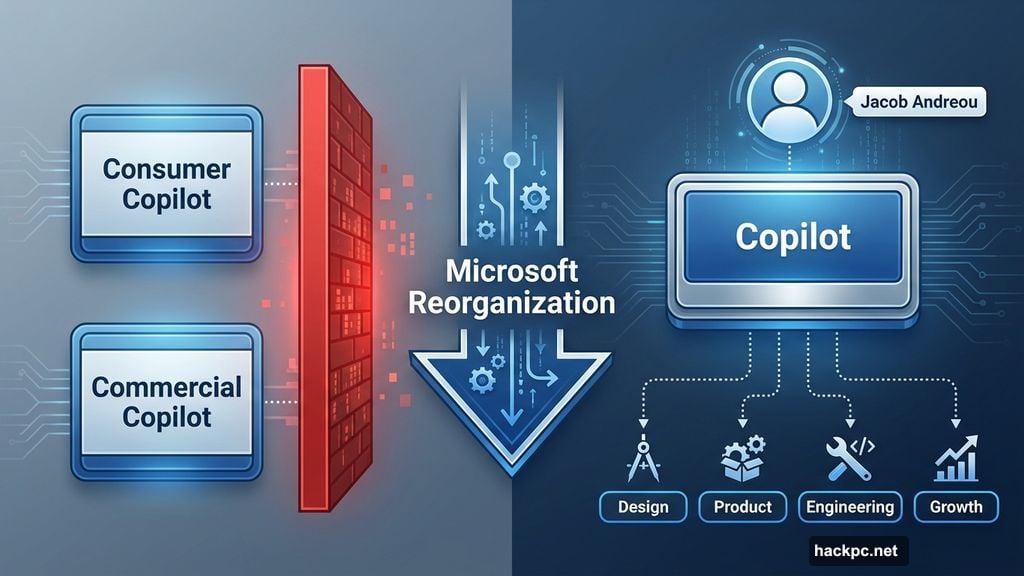
For years, the consumer and commercial versions of Copilot lived in completely separate worlds. Different teams, different features, different experiences. But that era is ending. Microsoft just announced a major leadership reorganization that puts one person in charge of the entire Copilot operation, spanning both business and everyday users.
Jacob Andreou Takes the Wheel
Jacob Andreou is now the single point of accountability for Copilot. He reports directly to Microsoft CEO Satya Nadella and owns everything — design, product, engineering, and growth — across consumer and commercial versions of the assistant.
Andreou joined Microsoft AI last year after time at Snap, where he also focused on product and growth. So he’s not a long-tenured Microsoft insider. But that might actually be the point.
His mandate is clear: unify what has been a fragmented, inconsistent experience. For anyone who has used both the consumer Copilot and Microsoft 365 Copilot, the disconnect has been obvious. They barely felt like cousins, let alone the same product.
Mustafa Suleyman Shifts Focus to AI Models
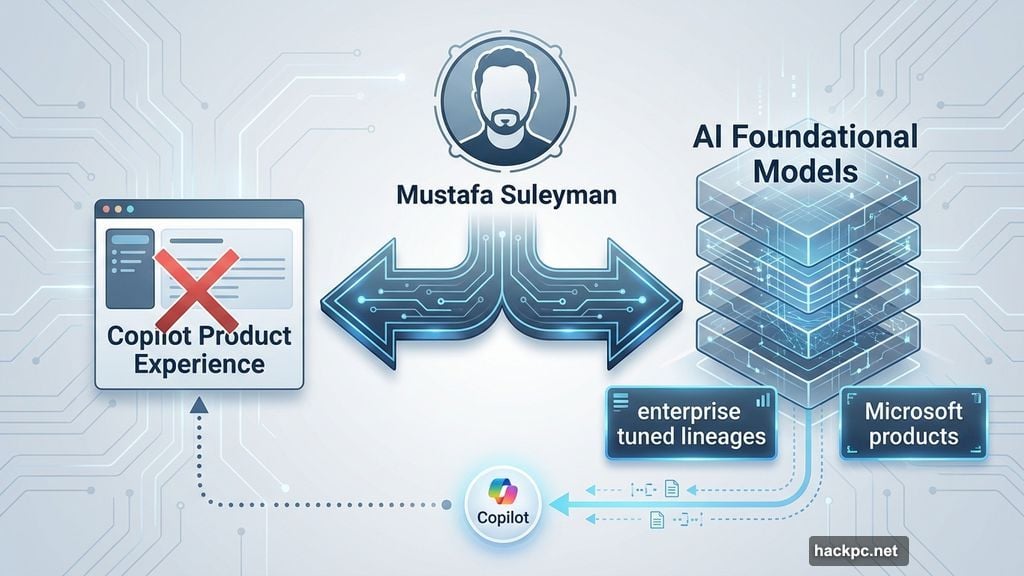
Meanwhile, Mustafa Suleiman — who joined Microsoft nearly two years ago after Microsoft brought in a group from Inflection AI — is stepping back from direct Copilot work. His new focus is building Microsoft’s own AI models.
That’s a significant pivot. Suleyman’s arrival originally shaped the consumer Copilot redesign, which drew clear inspiration from Inflection’s Pi assistant. Now he’s moving upstream, away from the product experience and into foundational model development.
In his internal memo, Suleyman described the model work this way: “These models will enable us to build enterprise tuned lineages that help improve all our products across the company.” He also noted that Andreou will retain a dotted line to him, and that he plans to stay involved in day-to-day operations.
So it’s not a clean break. But the reporting structure tells the real story.
A New Copilot Leadership Team Takes Shape
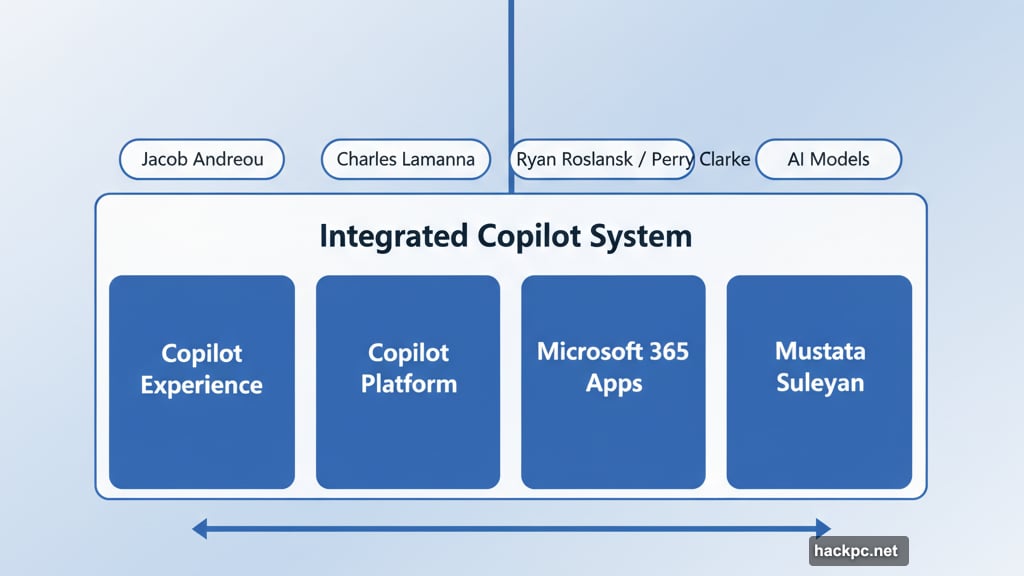
Microsoft is building a dedicated Copilot leadership team around four pillars: the Copilot experience, the Copilot platform, Microsoft 365 apps, and AI models.
Andreou leads the experience layer. Ryan Roslansky, Perry Clarke, and Charles Lamanna take responsibility for Microsoft 365 apps and the Copilot platform beneath it. Together, this group is supposed to move Microsoft from “a collection of great products to a truly integrated system,” as Nadella put it in his memo.
That’s ambitious language. But the intent makes sense. Right now, Copilot feels scattered. A unified leadership structure at least creates the conditions for a coherent product.
What This Really Admits
It’s hard to read this reorganization as anything other than Microsoft acknowledging that separating consumer and commercial Copilot development was a mistake.
The consumer Copilot has been experimental and inconsistent. The business version moved more cautiously. Neither benefited much from the other’s work. And crucially, nobody inside Microsoft truly owned the whole thing — a problem The Verge flagged previously.
This reshuffle tries to fix that. Whether it succeeds depends on execution, not org charts.
Big Questions Still Hanging
One piece of the puzzle remains unclear: what happens to Microsoft Edge, Bing, MSN, and the ad businesses that previously reported to Suleyman?
Microsoft made a huge push with Bing AI three years ago, eventually rebranding Bing Chat to Copilot. Those products presumably need a new home now that Suleyman is focused on models. Expect another announcement there soon.
This also isn’t the only recent departure shaking up Microsoft’s leadership. Rajesh Jha, executive vice president of the experiences and devices group, announced his retirement last week after more than 35 years at the company. Jha had overseen Microsoft 365 Copilot, Windows, and Office. And former Xbox chief Phil Spencer wrapped up his nearly 40-year run at Microsoft last month, with Asha Sharma stepping in as the new CEO of Microsoft Gaming.
Microsoft is heading into a new financial year with a noticeably different roster at the top. More team changes are almost certainly coming as the dust settles from these departures.
The Copilot reorganization is the most strategically significant move of the bunch. Getting it right matters enormously — not just for Microsoft’s AI ambitions, but for the millions of business and consumer users trying to figure out if Copilot is actually worth building their work around.




Comments (0)