
For decades, VPNs quietly did their job in the background. Businesses used them to share files securely. IT teams set them up without much fanfare. Nobody really thought much about them.
Then everything changed. Now, VPNs sit at the center of a growing political fight — and lawmakers around the world are starting to see them as the enemy.
VPNs Weren’t Always About Privacy
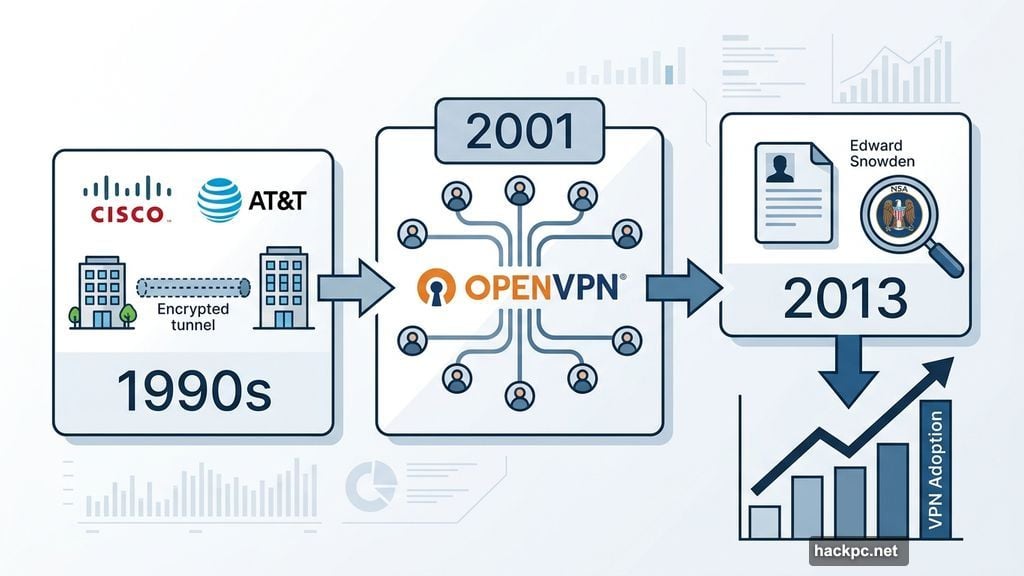
The whole idea behind virtual private networks started pretty simply. Back in the 1990s, companies needed a cheap way to send data between offices without paying for expensive dedicated lines. So engineers built encrypted “tunnels” through existing internet infrastructure to move information safely.
Microsoft, AT&T, and Cisco all developed early versions of this technology. Then in 2001, Francis Dinha and James Yonan launched OpenVPN, an open-source option that made the tech accessible to far more people — not just large corporations.
For years, VPNs stayed relatively niche. Most everyday users had no real reason to care about them.
Edward Snowden Changed Everything
That changed fast in 2013. When whistleblower Edward Snowden leaked documents revealing the National Security Agency had been running mass surveillance programs, millions of people suddenly got very interested in protecting their digital lives.
A 2015 Pew Research survey found that 34 percent of Americans had already taken at least one step to protect their privacy online. Just a year later, another Pew survey found 86 percent of Americans had tried to “remove or mask their digital footprint” — clearing cookies, encrypting emails, or using VPNs.
The rise of streaming helped too. Region-locked video libraries gave VPNs a very practical, everyday use case. If your favorite show wasn’t available in your country, a VPN fixed that in minutes.
Now Age Verification Laws Are Driving a New VPN Surge
Today, a new wave of VPN adoption has arrived — and this time, age verification laws are driving it.
Governments everywhere are passing rules requiring users to prove their age before accessing certain websites and platforms. The stated goal is protecting kids online. But the practical effect falls on everyone.
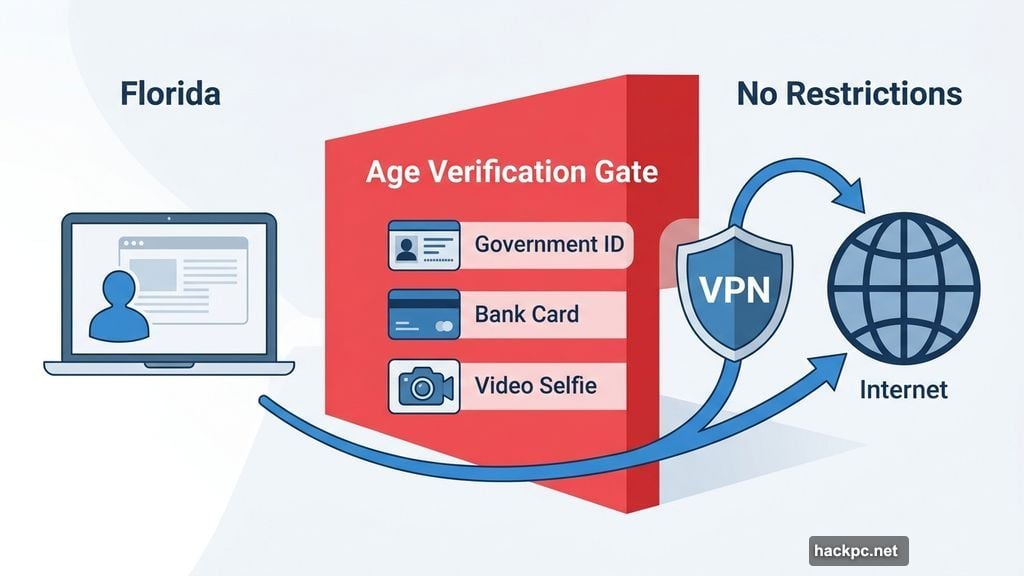
These systems often ask users to upload a government ID, enter bank card details, or record a video selfie just to browse certain content. That’s a lot of sensitive personal information handed over to websites — information that could end up exposed in data breaches.
So people are turning to VPNs to get around it. By masking their location, users can make their web traffic appear to come from a different state or country — one without these requirements in place.
The results have been dramatic. When Florida introduced mandatory age verification for adult websites, searches for VPNs spiked immediately. The same thing happened in the UK after age check rules expanded to cover not just adult sites but platforms like Reddit, Bluesky, and Discord. Australia saw similar VPN growth after banning kids under 16 from social media in late 2025 and rolling out age checks for porn websites.
Lawmakers Want to Close the VPN “Loophole”
Here’s where things get concerning. Politicians are noticing that VPNs undercut their age verification efforts — and some want to do something about it.
In Michigan, six Republican representatives proposed a bill that would not only restrict VPN access but also ban porn distribution, force internet service providers (ISPs) to “block and filter” wide categories of adult content, and target depictions of transgender people online. Wisconsin lawmakers included a VPN ban in their state’s age verification bill too, though they later removed it after significant public backlash.
The pressure isn’t limited to the US. In the UK, Children’s Commissioner Rachel de Souza called VPNs a “loophole that needs closing” during a BBC interview. The UK’s communications regulator, Ofcom, is actively monitoring VPN usage, according to TechRadar. In France, the Minister Delegate for Artificial Intelligence and Digital Affairs, Anne Le Hénanff, said VPNs are “the next topic on my list” after the country’s social media ban for kids under 15 took effect.
Who Actually Uses VPNs — and Why This Matters
Restricting VPN access wouldn’t just inconvenience people trying to watch Netflix from another country. The Electronic Frontier Foundation (EFF) points out that VPNs serve critical safety functions for journalists, activists, LGBTQ+ community members, and others who depend on anonymity online to stay safe.
Businesses and students use VPNs daily to securely connect to internal networks and communications platforms. For many people in certain parts of the world, a VPN is the only way to access information freely.
The Cato Institute, a libertarian think tank, has raised another uncomfortable point. Countries that ban or severely restrict VPNs include North Korea, Russia, and China — governments that use such restrictions to maintain authoritarian control over information. Putting the US, UK, and Australia in that company should give lawmakers pause.
And practically speaking, a VPN ban probably wouldn’t even work. Determined users would simply build their own private networks or find other technical workarounds. The people most harmed by restrictions would be ordinary users, not the tech-savvy individuals such laws claim to target.
The Age Verification Push Is Moving Fast — Maybe Too Fast
Online age verification is still a deeply imperfect system. The technology is inconsistent, privacy protections vary wildly across different platforms, and the actual effectiveness of keeping minors away from harmful content remains genuinely unclear.
Despite all that, lawmakers keep pushing forward. Earlier this month, a package of online safety bills advanced that could implement age verification directly at the app store level. Representative Alexandria Ocasio-Cortez called the package a “smoke screen” for Big Tech lobbying interests. Apple has already started rolling out age verification requirements in its App Store in response to laws in Brazil, Australia, Singapore, Utah, and Louisiana.
The rush to build an age-gated internet is accelerating faster than anyone has figured out how to do it safely or effectively. And VPNs — one of the most important tools ordinary people have to protect their privacy — are increasingly ending up in the crosshairs.
What’s particularly frustrating is the framing. VPNs aren’t a loophole. They’re a legitimate privacy and security tool used by millions of people for completely reasonable purposes. Treating them as an obstacle to government policy goals says something important about where these age verification efforts are really headed. Worth paying attention to.


Comments (0)