
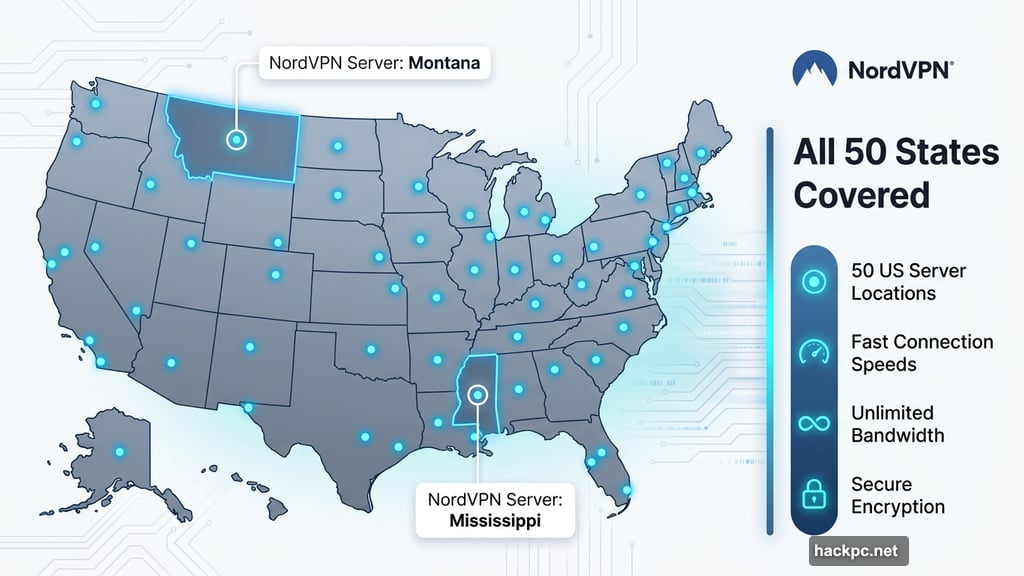
NordVPN quietly became one of the very few VPN providers with a server in every single US state. That’s a bigger deal than it sounds.
The company now covers 211 server locations total. And for anyone who’s ever tried to watch a regional sports stream while traveling, or needed a local IP address in a specific state, this expansion changes things considerably.
All 50 States. Why That’s Rare
Most VPN providers cluster their US servers in major cities. New York, Los Angeles, Chicago. The usual suspects.
So if you’re traveling through Montana or Mississippi and need a local connection, you’re often out of luck. Only a handful of VPNs actually solve this problem. ExpressVPN does it. Private Internet Access (PIA) does it. And now NordVPN joins that short list.
Moe Long, senior VPN editor at CNET, put it well: “Servers in all 50 US states make it a great option for unblocking regional sports matches in the US, or traveling to and within the US.”
That’s the practical win here. State-level server coverage means you can grab a local IP address almost anywhere in the country, which matters for location-sensitive services that check your connection point carefully.
The 100Tbps Network Capacity Boost
Alongside the geographic expansion, NordVPN pushed its total global network capacity to 100Tbps. That’s a serious number.
Higher capacity means the network handles more users simultaneously without slowing down. Peak hours, busy weekends, major streaming events — these are the moments when VPN speeds typically take a hit. More capacity gives the network breathing room.
NordVPN CTO Marijus Briedis explained the thinking behind the state-by-state approach: “A state-level presence helps users connect to location-sensitive services without sacrificing privacy. With broader coverage, users can pick the server that best fits their needs — speed, locality or redundancy — without compromising on security.”
That last part matters. More server options mean you’re not stuck choosing between a fast server and a nearby server. Ideally, you get both.
How NordVPN Stacks Up Against Proton VPN
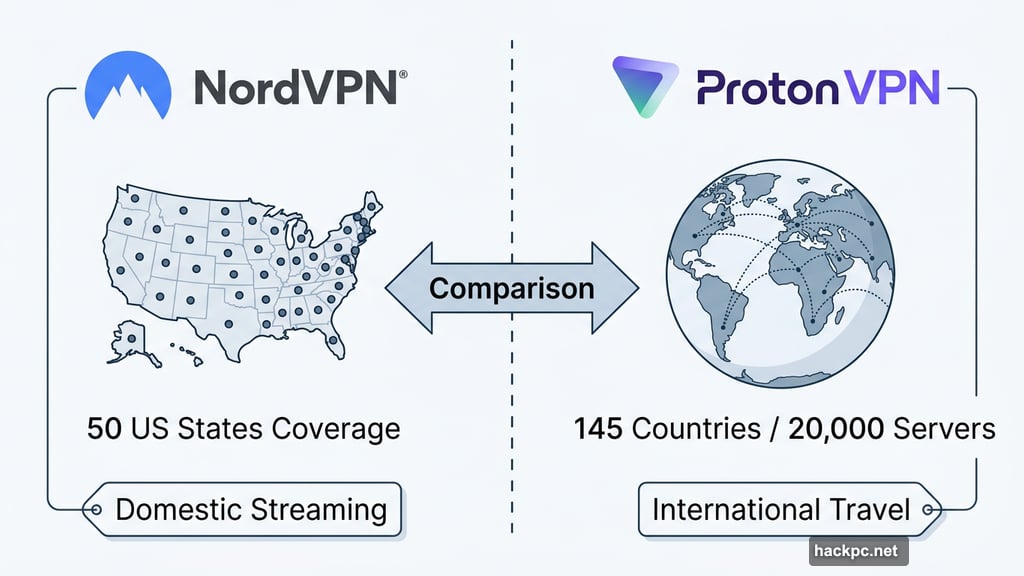
Proton VPN is the obvious comparison here. It runs about 20,000 servers across 145 countries — numbers that dwarf NordVPN’s totals.

But Proton VPN doesn’t have servers in all 50 US states. So despite the larger overall network, it loses ground on domestic coverage specifically.
This doesn’t make one provider objectively better than the other. Proton VPN’s global reach is genuinely impressive and matters more for international travelers. NordVPN’s state-level US coverage matters more for people focused on domestic streaming or location-specific US services.
Your best choice depends on where you actually travel and what you actually need to access.
NordVPN’s Global Momentum
This US expansion follows a busy stretch of international growth for NordVPN. Over the past year, the company entered several new countries including Fiji, Barbados, and Chad.
That kind of global footprint expansion matters for travelers. The more countries a VPN covers, the more likely you’ll find a reliable server wherever you land. And for streaming specifically, broader coverage opens up more regional content libraries.
Before You Sign Up, Know This
Two things worth keeping in mind before jumping straight to NordVPN.
First, some US states are actively considering laws that would restrict or limit VPN use. It’s worth checking the regulatory situation in your state, particularly if you’re planning to use a VPN for work or sensitive communications.
Second, NordVPN currently offers a significant discount on two-year plans that brings the monthly cost down to around $3. That’s genuinely competitive pricing for a full-featured paid VPN. But if budget is the priority, free VPN options do exist — and it’s worth exploring those before committing to a subscription.
Is This Expansion Worth Your Attention?
Honestly, yes — especially if you’ve ever run into regional streaming blocks or needed a state-specific connection inside the US.
Server count and location coverage aren’t flashy features. They don’t make for exciting marketing screenshots. But they matter enormously in practice, particularly when you’re traveling and trying to access content or services that check your location carefully.
The combination of all-50-state coverage, 211 total locations, and 100Tbps network capacity puts NordVPN in a strong position for US-focused users. Whether that makes it the right VPN for you depends on your specific needs — but it’s harder to dismiss now than it was before this expansion.




Comments (0)