

Music and AI have had a complicated relationship. Now Google wants to make it even more interesting.
Lyria 3 is Google DeepMind’s most advanced AI music model, and it’s trying to do what tools like Suno and Udio have been doing in the viral AI song space — but with more polish, better structure, and a whole lot of legal drama already swirling around it. You type a prompt, describe a mood, upload a photo, and within seconds you’ve got a complete track with AI-generated cover art.
Sound exciting? It kind of is. But there’s a lot more going on under the hood than a simple “make me a song” button.
What Lyria 3 Actually Does
Lyria 3 is what’s called a multimodal AI model. That’s a fancy way of saying it works with more than one type of input. You can feed it text, audio, or even an image, and it composes music that fits whatever mood or visual you throw at it.
The big improvement over earlier Google music experiments is consistency. Previous models could generate short bursts of sound, but Lyria 3 keeps melody, rhythm, and style coherent from the beginning of a track all the way to the end. It produces high-fidelity stereo audio at 48kHz — which is studio-quality resolution — and handles real song structure including intros, verses, choruses, bridges, and outros.
Google launched Lyria 3 in February, then followed up in March with Lyria 3 Pro, the more powerful version aimed at developers and professional creators.
Two Versions, Different Audiences
Not everyone gets the same experience, and that’s by design.
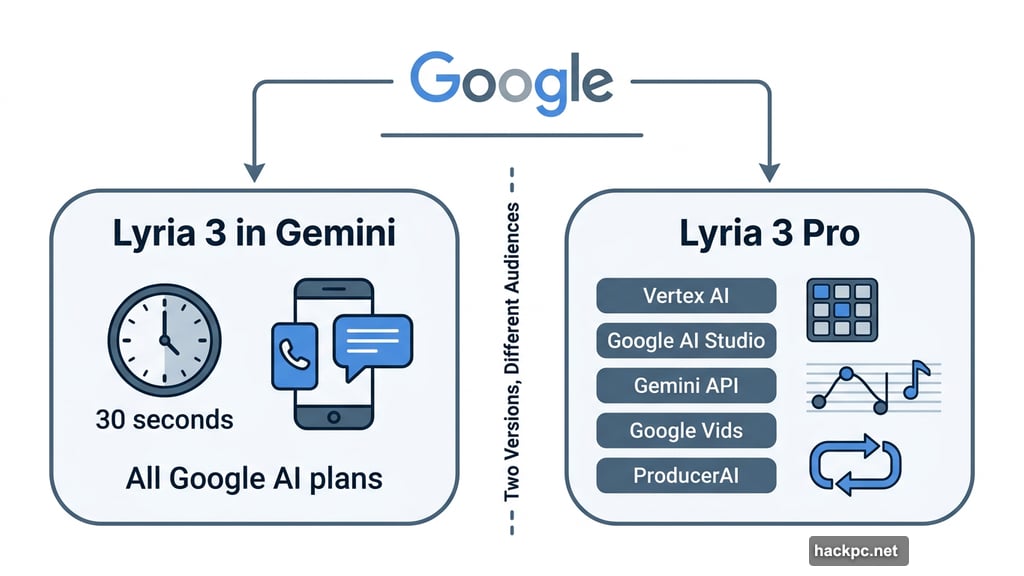
Lyria 3 inside Gemini is the simpler entry point. You describe a song, or drop in an image, and Gemini spits out a 30-second track. Choose the Thinking model and you can push it to generate longer pieces. It’s quick, accessible, and included across all of Google’s AI plans — though paid subscribers get higher generation limits.
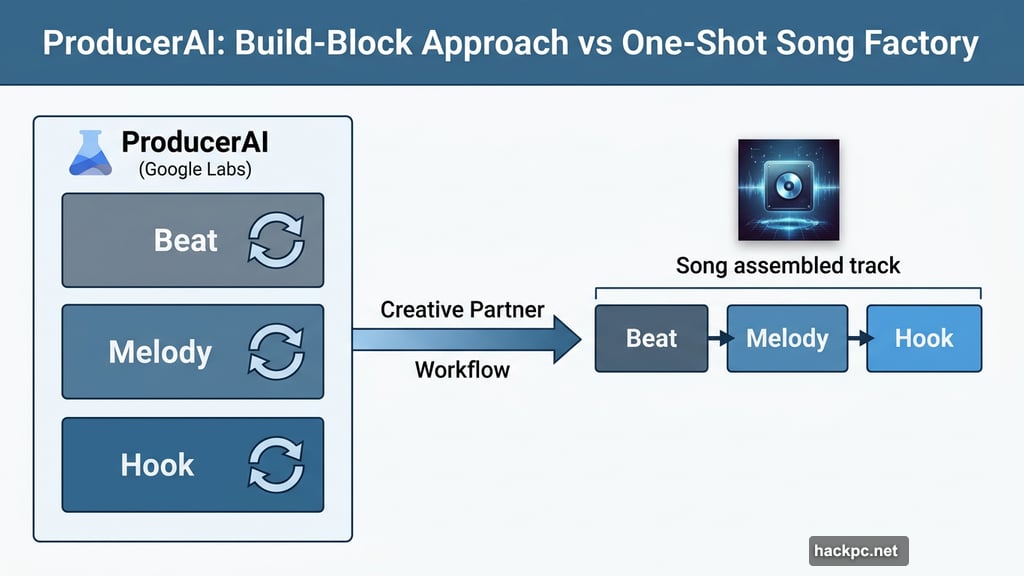
Lyria 3 Pro goes deeper. It’s available through Vertex AI, Google AI Studio, the Gemini API, Google Vids, and a platform called ProducerAI, which Google brought into Google Labs in February. ProducerAI positions itself less as a one-shot song factory and more as a creative partner. You can generate full tracks, but also individual building blocks — a beat here, a melody there, a hook you can keep reshaping. That distinction matters more than it sounds.
Prompting Is Where the Magic Happens
Getting good results from Lyria 3 comes down to how well you craft your prompt. A vague instruction like “make me a catchy pop song” will produce something, but probably not what you imagined.
Google suggests a structured approach: Genre and style + Mood + Instrumentation + Tempo and rhythm + Vocal style and language + Lyrics. So instead of “upbeat pop song,” you’d try something like “indie pop, euphoric, acoustic guitar and synths, medium tempo, female vocals, sung in Spanish, lyrics about summer road trips.”
John von Seggern, CEO of Futureproof Music School, puts it bluntly: “Words don’t translate to music one-on-one. You can’t type ‘make me a catchy pop song’ because that’ll always end up as something else.”
His take is that people find more success using AI to generate specific building blocks rather than trying to shape an entire composition with words alone. Google’s own prompting guide offers templates and detailed ideas if you want to experiment further.
Vocals, Languages, and Lyrics
Lyria 3 currently handles vocal and lyric generation in eight languages: English, Spanish, French, German, Portuguese, Hindi, Japanese, and Korean.
And these aren’t robotic voices reading words aloud. The model generates vocals with emotional inflection that actually matches the genre you’ve requested. Ask for a melancholy jazz ballad and the voice sounds different than if you ask for an energetic K-pop track.
You’ve got two approaches to lyrics. You can describe a theme or mood and let the AI write and sing everything for you. Or you can supply your own custom lyrics inside the prompt and have the model perform them. There’s even a timing control that lets you specify exactly when vocals start and stop within a track — useful if you want a long instrumental intro before the singing kicks in.
One neat trick: write your prompt in English but specify a different language for the actual performance, and Lyria 3 handles the translation and vocal delivery automatically.
Who Is This Actually For?
Google is positioning Lyria 3 as a serious creative tool, not just a novelty. But the realistic sweet spot is pretty clear.
Digital creators, YouTubers, podcasters, and social media users are the obvious target audience. Need background music for a video? Something original for a demo reel or pitch? A quick jingle for a social post? Lyria 3 handles all of that without licensing headaches — at least in theory (more on that shortly).
Von Seggern described it well: “I felt it was designed for, ‘I’m making a three-minute video for YouTube, and I need some kind of average backing music under my YouTube documentary.’ It’d be perfect for that.”
Google also sees education as a key use case, particularly for students who don’t have access to instruments or well-funded music programs. And developers building apps or products that need original audio can tap Lyria 3 Pro through the API.
But if you’re dreaming of prompting your way to a record deal, pump the brakes. As von Seggern notes, “If you want more granular control over what you’re doing, then you’re going to need to know what you’re doing on some level.”
Is the Music Any Good?
Honestly? It depends on what you need it for.
Von Seggern, who works professionally in music education, said the audio quality is “quite good.” But he was less impressed by originality. “I was disappointed that it seemed pretty generic,” he said.
That’s a fair critique. Lyria 3 produces technically solid audio that sits comfortably in whatever genre you request. But “technically solid” and “emotionally compelling” aren’t the same thing. Music is where people form deep personal connections, which makes AI-generated tracks more sensitive to scrutiny than AI-generated text or images.
The internet is already flooded with low-quality AI content. Whether Lyria 3 rises above that depends entirely on how creatively you prompt it — and whether you use it as a shortcut or as a starting point.
Copyright, Ownership, and a Growing Legal Battle
This is where things get complicated fast.
The US Copyright Office’s January 2025 report makes one thing clear: AI-generated music can only receive copyright protection when a human adds meaningful creative input. A song generated purely from prompts, with no additional human creative work, likely can’t be copyrighted. What counts as “meaningful creative input” is still being interpreted, but the bar is real.
Relani Belous, founder of Belous Law Corporation and The Trademark Channel, says people should think carefully before trying to monetize AI-generated tracks. She recommends understanding the terms of service, knowing the legal risks, and consulting an expert before hitting publish.
There’s also the training data question, and it’s already producing lawsuits. A group of independent musicians and songwriters sued Google in March, accusing the company of training Lyria 3 on copyrighted recordings — specifically, “at least 44 million clips and 280,000 hours of music” pulled from YouTube without permission or compensation. Google responded that it trained Lyria 3 using materials it has the right to use under its terms of service, partner agreements, and applicable law.
Belous added a pointed observation about fair use, which is widely misunderstood: “Fair use is not a right. Fair use is an affirmative defense, which means you’ve done something that is infringing, but it means you have an affirmative defense to do that.”
On the watermarking side, Google does embed SynthID into all AI-generated audio from Gemini. SynthID is an invisible, inaudible watermark woven directly into the audio signal, designed to identify content as AI-generated even after editing or compression. Lyria 3 Pro is also built to avoid directly mimicking specific existing artists.
What Artists Are Saying
The music industry’s response to AI generation has been mixed, and Lyria 3 is no exception.
Grammy-winning artist Wyclef Jean actually used Lyria 3 as part of his creative process while developing his song “Back From Abu Dhabi.” His take on the human-AI relationship was characteristically philosophical: “There’s one thing we have over AI, and that’s soul. There’s one thing that AI has over us, and that’s infinite creation,” calling the combination of both “invincible.”
Grimes has taken a more open stance, publicly offering a 50% royalty split on any successful AI-generated song that uses her voice — treating AI collaboration like any other artist collaboration.
Others have pushed in darker directions. In 2025, Spotify removed an AI-generated song uploaded under the profile of late country singer Blaze Foley, who died in 1989. Nobody asked his estate or had permission.
Belous sees the bigger picture clearly: “I think there’s an enormous amount of uncertainty and risk here that needs to be balanced out, and that’s something that will be vetted out over the years, like we see with new technology.”
She also noted that licensing agreements are already shifting, with AI-related clauses quietly appearing in contracts across the industry.
Lyria 3 is technically impressive and genuinely useful for specific applications. But the most interesting question isn’t whether it can generate a song in seconds. It’s whether AI music can develop enough soul to make people actually care about it. Right now, that answer is still very much unwritten.



Comments (0)