
Proxy servers have been around since the early 1990s. Back then, they had one job: cache frequently visited web pages so they’d load faster. Simple, practical, useful.
Fast forward to today, and proxies have grown into something much more complex. Businesses use them for web scraping, market research, content filtering, and network management. But they’re not right for everyone, and picking the wrong tool for the job can cost you time, money, and security.
Let’s break down exactly what proxy servers do, where they shine, and where you’re better off looking elsewhere.
How Proxy Servers Actually Work
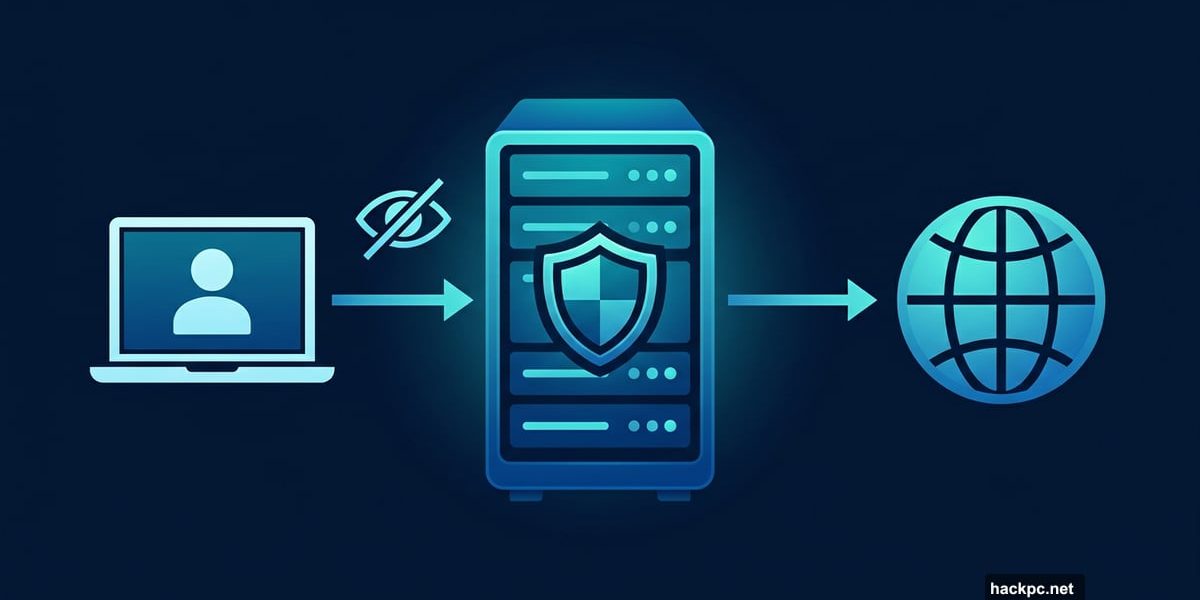
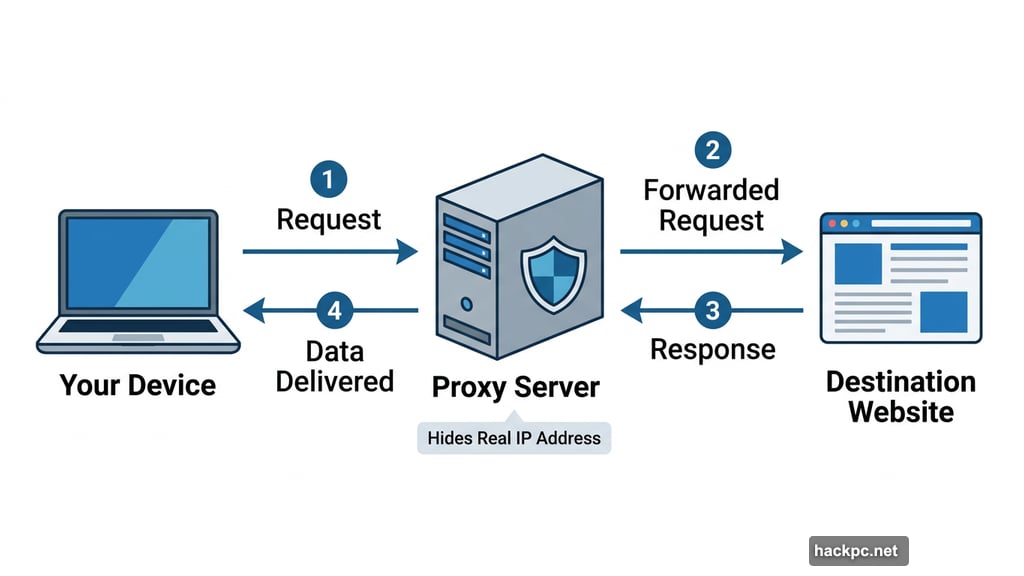
Think of a proxy server as a go-between. When you visit a website normally, your device connects directly. With a proxy, your request travels to a separate server first. That server then contacts the website on your behalf.
The website never sees your real IP address. It sees the proxy’s instead.
“It’s an intermediary,” said Erik Avakian, a technical counselor at Info-Tech Research Group and former chief information security officer for the Commonwealth of Pennsylvania. “It’s coming from somewhere else, so the person’s source IP is protected.”
Here’s what the full journey looks like:
- Your device sends a request to the proxy server
- The proxy forwards that request to the destination website
- The website sends its response back to the proxy
- The proxy delivers that data to you
From a user’s perspective, browsing through a proxy feels mostly the same as browsing without one. The main difference you’ll notice is speed. Adding that extra stop can slow things down, sometimes significantly.
The Real Reasons Businesses Use Proxy Servers
![Diagram illustrating how a proxy server routes web traffic between a user’s device and destination websites through an intermediary IP address]
Web Scraping at Scale
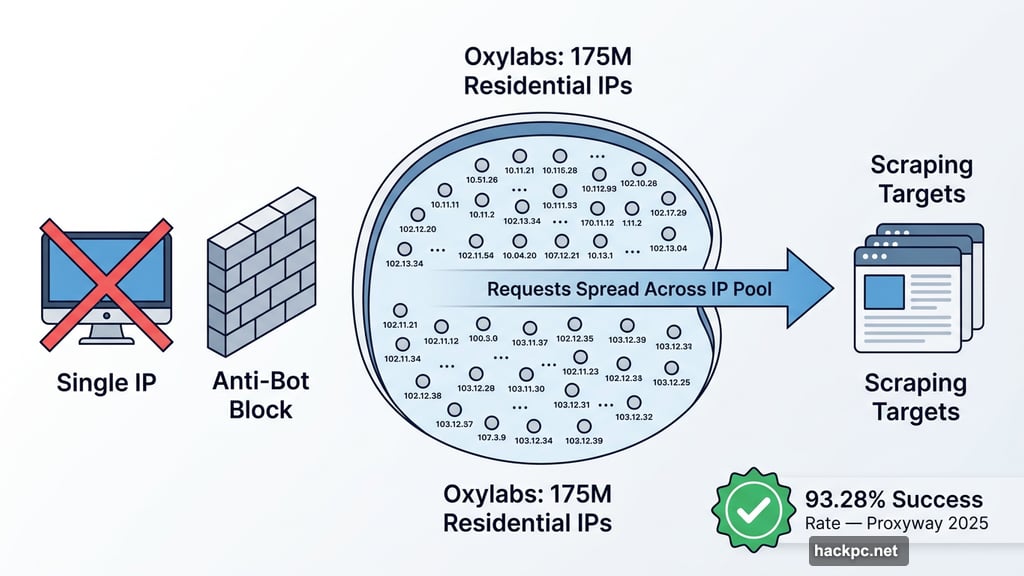
Web scraping is the most popular reason companies turn to proxy servers. When a business sends hundreds or thousands of requests from a single IP address, websites notice. Anti-bot systems kick in, block the IP, and the data collection stops cold.
Proxy servers solve this by spreading requests across thousands, or even millions, of different IP addresses. Websites see what looks like regular traffic from regular users. The scraping continues uninterrupted.
The best proxy providers maintain enormous IP pools to support this kind of work. In testing by CNET, Oxylabs stood out with more than 175 million residential IP addresses available. That’s a staggering number that helps explain why it posted a 93.28% average success rate with popular scraping targets, according to Proxyway’s Proxy Market Research 2025.
Content Filtering and Network Security
Businesses also use proxy servers as gatekeepers for their internal networks. A proxy sitting between employees and the internet can block malicious sites, prevent phishing attacks, and restrict access to non-work platforms like social media.
This works in both directions. Reverse proxies, which we’ll explain shortly, can filter incoming traffic to protect company servers from outside threats. Individuals can use this same filtering approach at home to control what sites are accessible on their home network.
Geo-Targeting and Localized Market Research
Here’s where proxy servers get genuinely interesting for market researchers. If your business needs to understand how a product or service looks to customers in different locations, a proxy lets you see what they see.
During a review of Decodo’s proxy service, the author was able to select specific ZIP codes within the United States to access localized proxy servers. For industries like auto insurance, where prices vary dramatically by location, that level of geographic precision is invaluable. You can collect localized pricing data from dozens of markets simultaneously.
Caching, Load Balancing, and Network Performance
![Diagram showing reverse proxy architecture with load balancing distributing traffic across multiple backend servers]
Caching is the original proxy superpower, and it still works. By storing copies of frequently accessed content locally, a proxy server lets multiple users retrieve that content faster without hitting the source server every time.
Load balancing spreads incoming traffic across multiple backend servers instead of overloading a single one. This improves performance and also builds in some resilience. If one server goes down, traffic routes to others automatically.
When a Proxy Server Is the Wrong Choice
Proxy servers solve specific problems well. But for many common situations, they’re not the right tool.
Individual Privacy: VPNs Win Here
If you’re an individual who wants better online privacy, a VPN is almost always the smarter choice. The reason comes down to encryption.
Proxy servers route your traffic through a different IP address, but they don’t encrypt it. Anyone watching the connection between you and the proxy can still read your data. VPNs encrypt everything, wrapping your traffic in a protective layer that makes it unreadable to outside observers.
VPNs are also far simpler to use. Setting up a proxy requires digging into network settings, finding configuration files, and running setup scripts. A VPN is download the app, pick a server, connect. That’s it. CNET’s testing found that the fastest VPNs kept speed loss to around 25% or less, which is reasonable for everyday use.
Speed-Sensitive Activities Like Online Gaming
Proxy server speeds vary widely, and the results aren’t always pretty. During CNET testing, many proxy connections returned download speeds as low as 1Mbps with extremely high latency. That’s because your traffic might be routing through a server on the other side of the world.
For online gaming, streaming in HD, or anything that needs fast, stable connections, most proxy servers will frustrate you. A VPN optimized for gaming handles those needs much better.
Free Proxy Servers: Not Worth It
Free proxy lists exist across the internet. Avoid them.
Free proxies are typically slow, unreliable, and constantly going offline. Because you’re sharing them with many other users simultaneously, most websites have already blacklisted those IP addresses. For web scraping purposes, free proxies are essentially useless. And for privacy, they may actually create more risk than they solve.
Proxy Alternatives Worth Knowing About
VPN
Best for everyday privacy, geo-restricted streaming, and online gaming. VPNs encrypt your traffic system-wide, covering every app on your device. You pay a monthly subscription rather than per gigabyte. The encryption theoretically slows your connection, but testing shows the fastest VPNs keep that impact minimal. You can even install them on Wi-Fi routers to protect your entire household automatically.
Tor Browser
Tor is a free, open-source option that routes your traffic through three volunteer-run servers called nodes: an entry node, a middle node, and an exit node. This layered approach gives strong decentralized anonymity. The catch is speed. Traveling through three separate servers makes Tor noticeably slower than both VPNs and proxy servers. HD streaming and online gaming aren’t really viable options here.
| Feature | Proxy Server | VPN | Tor |
|---|---|---|---|
| Primary Use | Web scraping, caching, market research | Encryption, unblocking geo-restricted content | Decentralized anonymity |
| Encryption | None | Yes | Yes |
| Speed | Moderate to fast | Moderate | Very slow |
| Coverage | App-specific (browser) | System-wide (all apps) | Browser-specific |
| Cost | Pay per GB or IP | Monthly subscription | Free |
| Best For | Business use cases | Everyday privacy and security | Open-source anonymity |
The Risks You Should Know Before Buying
Unethical IP Sourcing
Not every proxy provider plays by ethical rules. The IP addresses in a proxy pool have to come from somewhere. Legitimate providers are transparent about how they acquire them, compensating device owners and obtaining explicit consent for using their IP addresses.
Some providers aren’t so careful. In January 2026, Google took legal action to shut down a proxy network with millions of IP addresses that it said was “leveraged by a wide array of bad actors.” Before purchasing any proxy service, research how the company sources its IPs. If they can’t explain their acquisition process clearly, that’s a serious warning sign.
Terms of Service and Legal Considerations
Using a proxy server for web scraping is generally legal, but the activity it enables might not be. Several high-profile legal cases have challenged web scraping practices. Reddit filed a lawsuit against AI search developer Perplexity over scraping its content.
“Web scrapers and those who host or rely on scraped personal data also should be aware of all applicable privacy regulations governing their activity and seek legal advice to ensure that they are complying with these regulations,” notes a post from law firm Quinn Emanuel on the subject.
If you’re unsure whether your specific use case runs afoul of a website’s copyright policy or terms of service, talk to an attorney before starting.
A Quick Guide to Proxy Types
Browsing proxy options can feel overwhelming. Here’s what the most common categories actually mean.
Forward vs. Reverse Proxies. A forward proxy handles outgoing requests from your device, sending them out to the internet. A reverse proxy sits in front of a server and filters incoming requests. Companies use reverse proxies to hide their server IP addresses and protect against direct attacks. “Corporate environments that have websites don’t want those IP addresses exposed, so they’ll have a reverse proxy at the front end,” Avakian explained.
Residential Proxies. These use IP addresses issued by actual internet service providers. Websites see them as regular home users. They’re highly trusted and less likely to trigger anti-bot systems.
Mobile Proxies. The most expensive type, mobile proxies use IP addresses tied to actual wireless carrier devices. They’re the go-to choice for scraping sophisticated targets like social media platforms.
Datacenter Proxies. Hosted on servers from companies like AWS or Google Cloud, these are the cheapest option. They’re also the most likely to get blocked because websites recognize datacenter IP ranges easily.
ISP Proxies. Sometimes called static residential proxies, these are owned by ISPs but hosted in data centers rather than on end-user devices. They sit somewhere between residential and datacenter proxies in terms of both trust and price.
Shared vs. Dedicated IPs. Shared proxies let multiple customers use the same IP simultaneously. They cost less but perform worse, and you risk having your shared IPs blacklisted because of what other users do with them. Dedicated proxies are yours alone, faster and more reliable, but they cost more.
So Should You Use One?
Proxy servers are purpose-built tools, not general-purpose privacy products. For businesses running large-scale web scraping operations, conducting geo-targeted market research, or managing corporate network security, they’re genuinely powerful and often essential.
For individuals who just want better privacy when browsing, a VPN handles that job better in almost every situation. It’s easier to set up, it encrypts your traffic, and it won’t leave you wondering whether your data is exposed.
The honest answer is that proxy servers serve a fairly specific audience: developers, data analysts, and business teams who need to collect data at scale without getting blocked. If that’s you, they’re worth the investment. If you’re just looking for a safer way to browse the internet, save your money and get a VPN instead.




Comments (0)