
Here’s something that might surprise you. Deleting the Signal app from your iPhone doesn’t necessarily delete your messages. Federal investigators just proved that in court.
Reporting by 404 Media revealed that the FBI extracted private Signal messages from an iPhone’s notification database, even though the app had already been removed from the device. Those messages were used as evidence in a domestic terrorism trial. And yes, the messages were set to disappear automatically using Signal’s built-in feature. The app deleted them correctly. The iPhone held onto them anyway.
This is a bigger deal than it sounds.
How the iPhone Notification Database Betrayed Signal Users
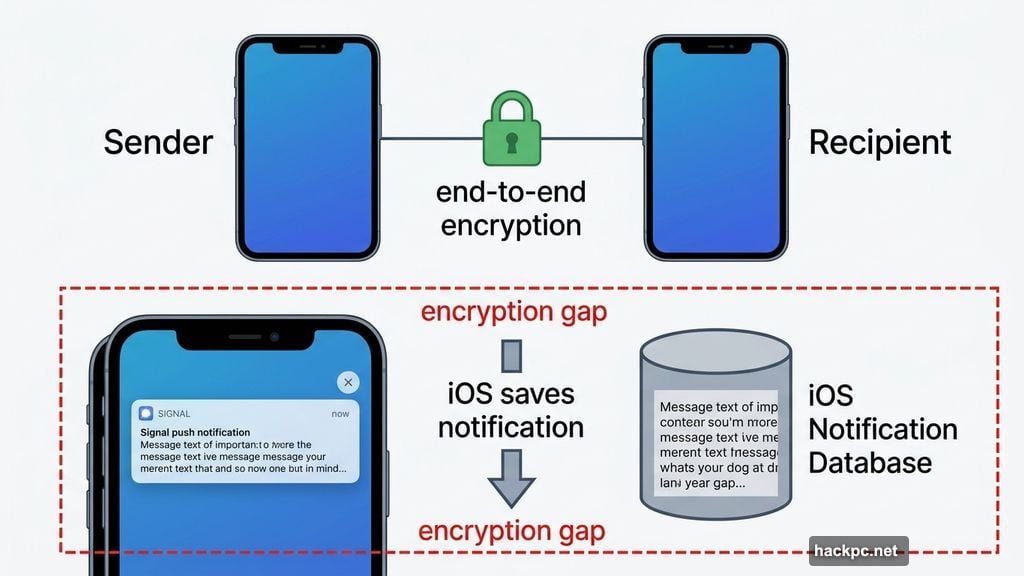
Signal is an end-to-end encrypted messaging app. The whole point is that nobody except you and the person you’re talking to can read your messages. That encryption is rock solid.
But here’s the catch. When a message arrives, your iPhone displays it as a push notification. And iOS saves those notifications to an internal database. So even after Signal deletes the message and even after you delete the app entirely, the raw text of that notification can still be sitting inside your phone’s storage.
The FBI exploited exactly this gap during the trial of nine people arrested after a July 2025 incident at the ICE Prairieland Detention Facility in Alvarado, Texas. An FBI special agent testified that Signal had been removed from the phone before investigators examined it. Still, the messages were recoverable. All nine defendants were eventually found guilty on charges ranging from aiding in domestic terrorism to attempted murder.
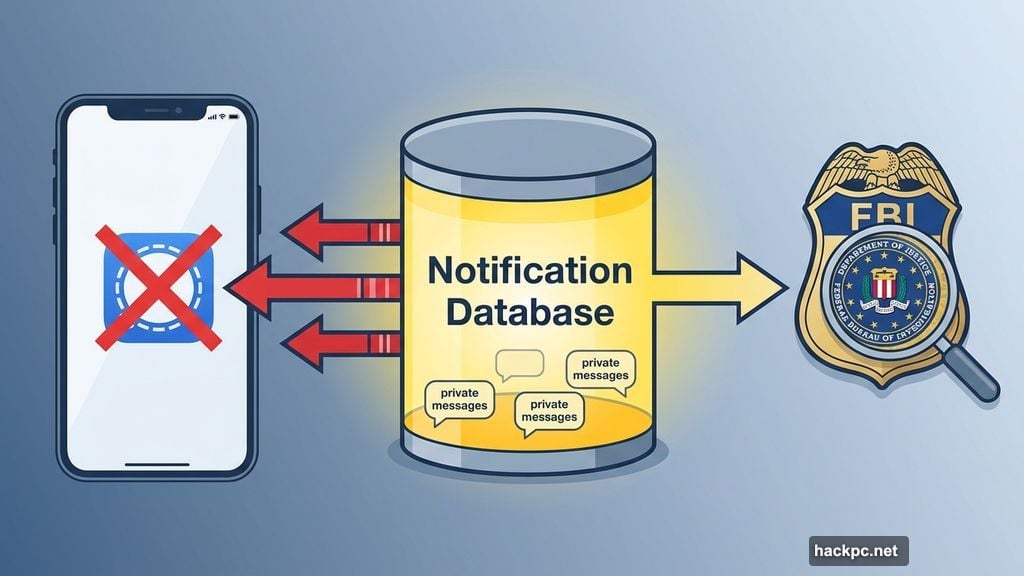
This isn’t a flaw in Signal’s encryption. It’s a flaw in how iOS handles notification data.
What Privacy Experts Are Saying
John Davisson, deputy director of the Electronic Privacy Information Center, didn’t mince words when he spoke to CNET about the issue.
“Someone who deletes a secure messaging app reasonably expects that their messages won’t hang around indefinitely or be retrievable if the device falls into untrusted hands,” Davisson said. “Apple owes it to the public to fix this problem, and developers should consider warning their users of the risk until that happens.”
That’s a clear call-out aimed directly at Apple. And it’s hard to argue with the logic. If you delete an app and its data, you probably assume the data is gone. In this case, it wasn’t.
Thorin Klosowski, a security and privacy activist with the Electronic Frontier Foundation, pointed out that the solution already exists inside Signal itself. “Signal has the option to control what (if anything) is shown in notifications,” he told CNET, “while for other apps, you may need to dive into the settings of notifications more generally.”
Signal, Apple, and the FBI had not responded to requests for comment at the time of reporting.
The Fix Is Already Built Into Signal
Good news: Signal anticipated this problem and built a solution directly into the app. The fix takes about thirty seconds to enable and works the same way on both iPhone and Android.
Here’s exactly what to do:
- Open Signal and tap your profile icon to access Settings
- Tap Notifications
- Find the Show option and change it to No name or message
That’s it. Once you make that change, Signal will still send you push notifications when a new message arrives. But the notification won’t contain any actual content. No sender name, no message preview. Just a gentle nudge to open the app.
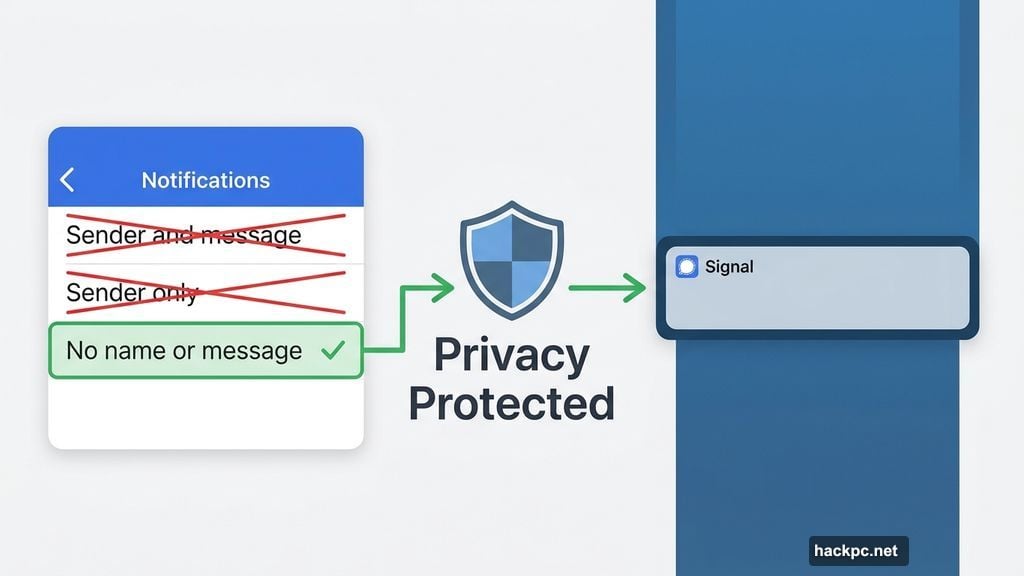
Yes, this means you’ll need to open Signal every time to see who texted you and what they said. That’s a small trade-off. But it closes the loophole completely. If no message content appears in the notification, no message content gets saved to your phone’s notification database.
Why This Matters Even If You’re Not Hiding Anything
You might be thinking this only matters for people doing something wrong. That’s not quite right.
Journalists, activists, lawyers, doctors, and everyday people all use Signal because they want genuine privacy. Domestic abuse survivors communicate with support networks through encrypted apps. Business professionals share sensitive information they have a legal duty to protect. People in authoritarian countries use these tools to stay safe.
The assumption underlying all of this is that encrypted messaging means private messaging. This case revealed a gap in that assumption that most people never knew existed.
The underlying encryption still works exactly as intended. Signal’s disappearing messages still delete from the app. But your iPhone was quietly saving copies of your message notifications without ever telling you. And that’s a problem Apple needs to address directly, regardless of how you feel about the specific trial where this came to light.
For now, the setting change above is your best protection. Enable it today if privacy matters to you at all.


Comments (0)